Winter weather is fading out, morphing into warm spring nights, and soon to transition to blistering, unending days and nights of the annual summer melt. The rest of the western hemisphere looks forward to the sun after a drab, colorless and lengthy winter. But me, not so much.
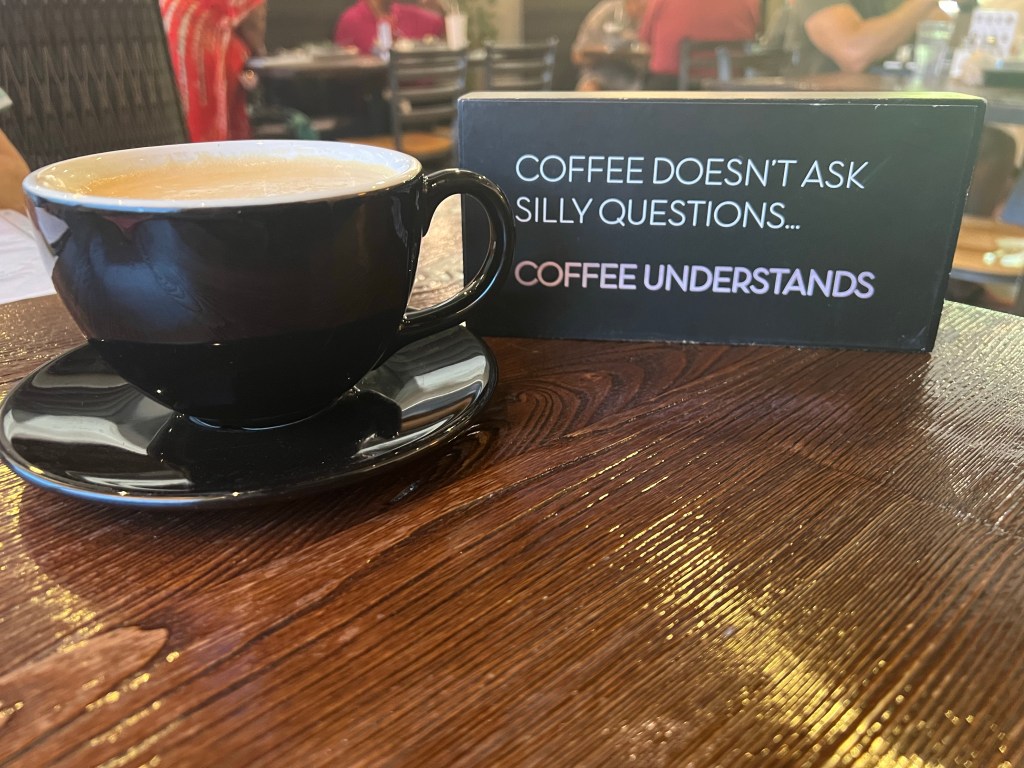
I will miss the savoring of the under-the-chin snuggle of the comforter layered atop the weighted blanket knowing with one quick fling of them off my body all warmth will dissipate. I’ll miss the quick tempo of bare feet racing to make the morning latte but stopping first to turn on the heating pad and portable heater, readying for my return. This is my way of saving on the gas bill, no need to heat the entire house when it’s just me occupying less that 10 square feet for an hour or so.
I will miss settling into recliner, covering toes, calves and thighs with the thick blue blanket for added comfort. The act of cupping the latte with both hands to disperse heat through to the bones; yes, I will miss this too.
I will miss lighting candles in the darkened room. Flickering candles lend to a peaceful atmosphere to start the day. Trading fleece bedsheets for cool cotton may have me reaching for the tissue as the removal of one last visage of winter/spring makes me weep.
I love that the dreary sky is bright again, but the sun is my frenemy. Outdoor activities come to a screeching halt and I’m an involuntary hermit once more. As the world turns and people are having fun in the sun, I search for ways to turn my world into fun within the comfort of air conditioning.
Enough lamenting, it’s time to shed the fleece––I know by the time I lay my head on the pillow the night air will be warm and I’ll be glad I did.
The Authorized King Jame Bible version has come down a notch or two in popularity in the religious world. Language has changed radically in the last four centuries, so it’s understandable why people prefer modern language translations or paraphrased editions.
My parents were in the die-hard Authorized King James Only group and many debates on the topic easily became heated. I learned not to bring the subject up during our visits. I would have placed money down of their willingness to be martyrs for the King James only stance.
My point with my parents and the KJV only tribe has always been language was meant to be understood and if God wrote it, wouldn’t he want us to understand it? What other purpose to the Bible would there be?
Consequently, all my childhood scripture learning was King James, and I memorized quite a bit. I was in the AWANA Club just to get out of the house every Wednesday night at our church. AWANA involved activities for kids and tons of scripture memorization. But I digress.
Since I became an adult no one tells me what Bible to read, I have explored several options. But for some reason I always go back and compare to my roots. I spent time pondering why this might be and I have deduced that the many verses in the KJV, waxes poetic and dramatic next to a few modern language publications.
For example, the KJV of Ephesians 3:21 reads, “to him be glory in the church by Christ Jesus throughout all ages, world without end.” The New Living Translation reads “Glory to him in the church and in Christ Jesus through all the generations forever and ever!”
“World without end” packs a harder dramatic punch for a chapter ending in my book. (Pun intended.)
Or how about the passage when the mob comes to arrest Jesus in the garden in John 18:5-6? Jesus is asked if he’s the one they are looking for and Jesus answers “I am he.” The hunters literally “went backward and fell to the ground.” (KJV).
The same passage in The Message simply says the crowd was “taken aback.” One reaction was visceral and the other an emotional response. Just saying. Just an observation into my past and present––I like other people’s drama. I am a writer after all.
INCIDENTALS: The sale of Bibles in the USA has increased 41% since 2019 until October 2024, according to Google. It remains the overall bestselling book of all time, with the New International Version named most popular modern English of those sales and King James near top of the list.
Mom surprised us all by going before Dad. 1,778 days later, he followed her.
In the intervening years Dad was capable and willing of doing for himself. But the 64-year relationship was built upon Mom doing all things indoors and Dad conquered outdoor chores on the small ranch. It fell upon a couple of family members to fill the gaps of cooking meals, a bit of banking, and other oddball tasks. For me, the oldest daughter, it was more about being with him as well as stocking the fridge with casseroles and desserts.
It meant Sunday afternoon visits after church. It was a short drive of about 20 miles to the childhood property I grew up on. It was still home to me despite Mom not being around.
One week necessitated a midweek trip to dear ole’ Dad’s. He needed my help with some banking back in my little town. Coincidentally, the tune “My Little Town” (Simon & Garfunkel) repeated in splendid reverie as I turned onto his little lane. I crooned the lyrics of the chorus, “nothing but the dead of night back in my little town,” and for reasons unknown curiosity compelled me to pull over and Google the lyrics to the full song.
I was stupefied to learn that for the past umpteen years I’ve been belting out incorrect words. According to lyrics.com, the correct lyrics are “nothing but the dead and dying back in my little town.” My bad.
At the time, dead and dying seemed to be more appropriate at that time; from 2016 to 2018 my little town had lost my mother and three aunties, two of whom I was especially close to. Dead and dying spoke
The lyric of the song seems to imply nothing productive comes from their little town whereas my little town has lost four bastions of strength, grace, faith and character.
I prefer to keep my version. Maybe it is born from habit of many years. Maybe it’s plain stubbornness––I’ll keep on keening “nothing but the dead of night.”
The Sunday afternoon and mid-week visits have ceased. Although the property now belongs to me another family lives there. When my outings take me to the little ranch at the end of the lane, it doesn’t feel like home, making the ancient adage true: you can’t go home again.
Gosh darn it––I must take my leave before this earworm leaves me in a puddle. (Insert humming sounds.)
On a dark and stormy night, no, I’m joking. It was a hot August night (for reals) when I experienced the phenomena––a life review––my life flashed before my eyes. Granted, it was a like a YouTube Short because I was only 18 years old at the time. It’s a boring name for a fantastical event––a life review. Can’t we come up with something more mysterious? Say like animated appraisal?
At the gloaming, after a laborious day of working in a lumber mill as a ty-up girl, I went to a friend’s house to relax and party a bit. I remember inhaling (unlike Bill Clinton) some wacky tobacky and washed the smokey dry throat with a beer or two. I don’t remember all the sordid details. And I did what all stupid people do; I drove my car the 6 miles to my home. The stigma of driving under the influence in the 1970s wasn’t as it is now, and back-in-the-day no one really gave it much of a second thought unless dire things happened. Shame on us.
All was well until I jerked awake at the wheel approaching the left bend of the exit from the I-5 freeway onto highway 273, exit number 667A. Literally a film of important life events streamed like a Hulu Original. And as stated, it was a short film of only 18 years. It was freaky this occurrence of my life review…er, I mean animated appraisal.
Twenty-three years later I was involved in an accident while riding in a truck and trailer hauling gasoline and diesel, a literal crash and burn scene. The likelihood of survival was slim but there was no life review. According to google scientific studies, this happens when a person thinks they are going to die. Tumbling around in the cab I believed I would die, but no flashes of life passing me by. Later that evening while unconscious I died and had to be revived two or three times, again no review. Just as well because 41 years of life would have a full-feature film.
I no longer drive under the influence of any substance; in case any are wondering.
My little town in far northern California has many now defunct signage––stores out of business, and some for many years. I am tempted many times to grab snapshots of each (most of them) carry childhood memories, but I am not a photographer. At least that is my excuse for failing to do so.
This sign of Gene’s Hamburgers has special memories of grammar school days with clothes shopping trips to the “big city” of Redding, California. We lived in the country between two tiny towns with few people about 20 miles south. My parents were frugal, pragmatic people. We rarely ate meals outside our home. We raised our own beef and had a large garden; the logic was why pay for food when we have plenty at home?
The rare exception was a trip to Redding for items not found in our local stores, such as the awful oxford black and white shoes we girls we forced to wear for the first few years of school. I would say God-awful but why should he get all the blame? But I digress.
Redding trips were exiting because cheeseburgers, fries, and Coca-Colas were on the lunch menu. And Gene’s Hamburgers was the family favorite. For decades Genes was the local social hangout for car enthusiasts, but today it has been razed including the sign. The lot sits empty and forlorn.
One the last meals I had with my grandmother was from this hamburger joint. I’m thankful I had the foresight to snap this pic years ago when I first heard of the plans to close the place.
There once was a little girl who had the nursery-rhyme curl in the middle of her forehead. Country folk like to call it a cowlick, named after the way a swirling pattern is fashioned when a cow licks the hair of her calf. But on humans it refers to a strand of hair that stands up or lies at an angle at odds with the rest of the hair. Little Girl was made with two––one on her forehead and one on the crown of her head.
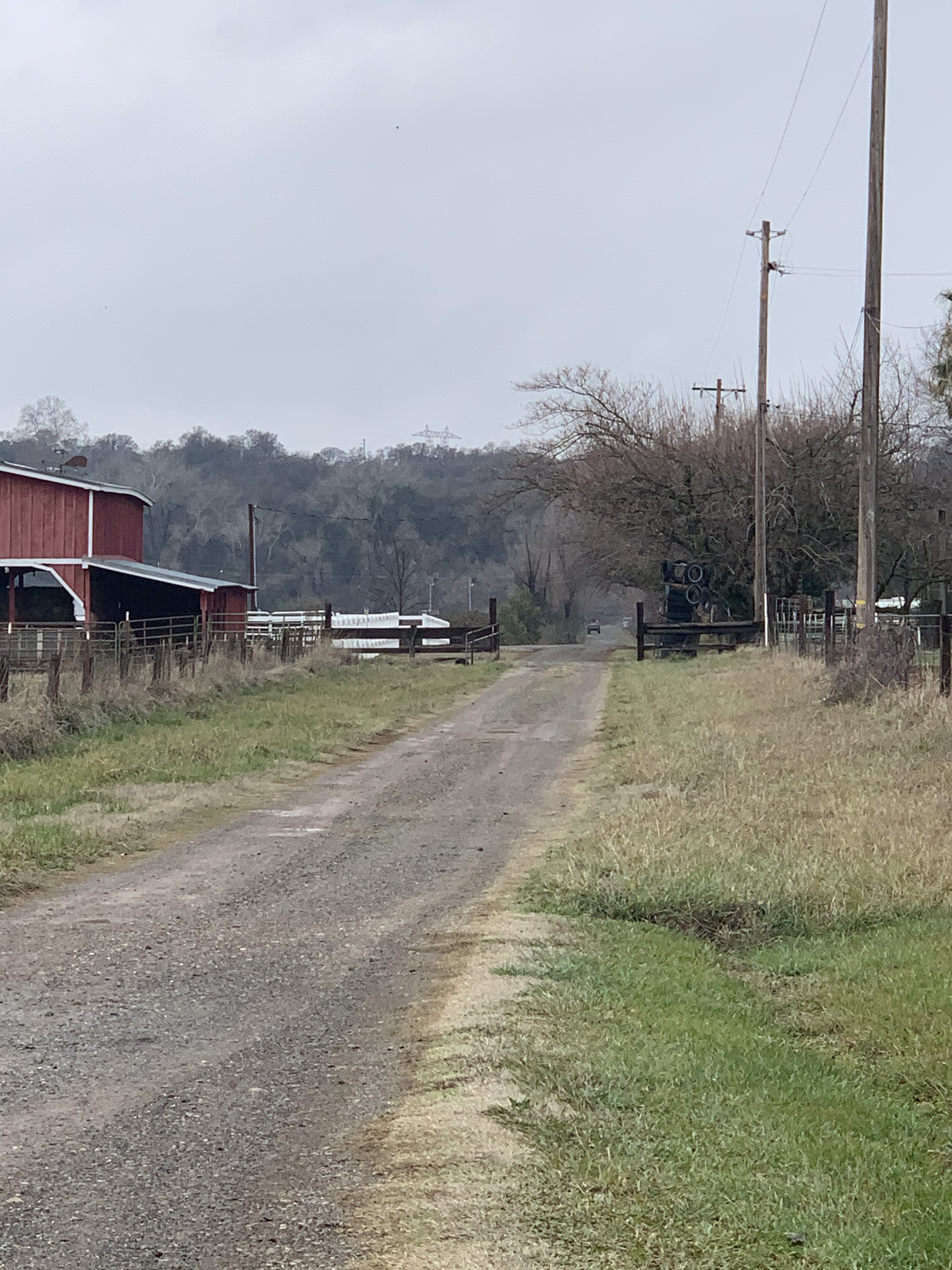
Heading down the lane to “home”. Photo taken in front of the former G.F. Spoon home.
Little Girl lived with her parents at the end of a dirt road; a road that seemed endless to a small girl. Her father’s parents, Grandma and Grandpa Spoon, lived at the mid-way point so that she passed their house when walking up or down the lane. Walking ‘up the lane’ meant going to the paved road that led into town. Walking ‘down the lane’ meant going home.
Her adventures of riding the school bus began at an early age. The bus was a big caterpillar looking mustard-colored machine that gobbled up kids early in the morning and carried them away to places where they were taught all sorts of things. The best thing about this bus was it brought them back to the end of the lane and spit them out in the afternoons.
Little Girl knew how to read fluently at four years old, so she skipped kindergarten and started the first grade at four, turning five years old three weeks later. She was able to read so young because her grandma, the one who lived up the lane, taught her. In fact, her Grandma Spoon taught most all her grandchildren to read for she was a retired schoolteacher.
On non-school days Little Girl walked up the lane to visit her mother’s parents, who also lived in the neighborhood. She visited the Watkins’ home often because she liked her grandma and had hopes of being given buttered toast covered with sugar. It was a secret treat just for Little Girl whose mother never allowed such a thing. Two uncles and one auntie also lived with Grandma and Grandpa Watkins, but Grandpa was rarely home because he worked in the woods far away. The uncles played guitars and Little Girl danced with her auntie to the catchy tunes. Sometimes she didn’t dance at all and watched Auntie twist to the music on her Twister Board. The Twist was all the rage in that day.
A visit to the Watkins’ home meant walking up the lane just past the Spoon home. The two homes were separated by a wide pasture and was catty-corner to the Spoons. So, she had to go under a barbed-wire fence and walk the pasture because she wasn’t allowed to walk on the paved road. The problem was the field was home to many cows and bulls and Little Girl was afraid of cattle. She always looked two or three times to be sure they were far away before risking being poked by the barbed wire fence while entering the field.
She hurried along the way looking over her shoulder to be sure no beast had her in their sights until she was safely over the wood fence into the Watkins’ yard. She loved being able to visit both sets of grandparents all by herself, no adult to scold her for this or that or anything at all. Or any pesky siblings to bother her.
After every school day, school bus #81 dropped her and her older brother to walk down the long lane to home. Their baby sister stayed home because she was just that, a baby. And babies didn’t go to school or ride busses.
A row of mailboxes sat on the edge of the dirt road ending a few feet before the paved highway perpendicular to the dirt road. Little Girl always opened the door of the largest mailbox first and snatched the stamped envelopes addressed to Mr. and Mrs. G.F. Spoon. Her brother never interfered, and she never knew why he was not interested in this fun chore.
It was fun to Little Girl because Grandma rewarded her with a dill pickle. Little Girl was well known for her love of dill pickles, but her mother never bought them because her father, nor her brother liked them. Some days Grandma was out of dill and substituted sweet or bread and butter. Little Girl didn’t like these pickles as much, but she still ate them.
If the weather was good, Grandma would be sitting in her rocking chair on the porch. She would ask if Little Girl was a good mailman or a bad one. She never really knew what she was but always answered “good.”
Sometimes Grandpa joined them but most times he was in his workshop behind the house. The shop was built by the old man out of blackened railroad ties. Many stood slightly crooked and off kilter. Little Girl learned late in life that the reason the thick square boards were blackened was because her father, in his early 20s, had accidently set fire to them. Yet he never confessed to Grandpa Spoon.
Grandpa Spoon was a small man whose boot size was only 7.5, small for the average man and was 5 foot 9 inches or so tall, or so they said. His stooped shoulders and wrinkly lines on his bespectacled face made him look shorter. But Grandma was robust making her appear slightly taller than her husband. He wasn’t as friendly to Little Girl as Grandma, so she didn’t seek him out if he was absent.
Little Girl’s home was about 1/8 mile from the elder’s Spoon Ranch, as it was called. She loved talking with her grandma, because Grandma had been a substitute teacher in nearly every school in Shasta County, California, and beyond. She had lots of stories to tell––stories about the old days.
One day she learned how Grandma earned her teaching credentials: She and her five children at the time stayed camped out in a tent in Mt. Shasta, California. She attended classes while the oldest children watched the younger in the campground. Sometimes Grandma took a child to school with her. She did this for about 6 weeks! Little Girl was impressed at the fortitude and courage Grandma demonstrated. Even at five years old she recognized her grandma as a free thinker, a woman ahead of her time. In that era, most married women did not work on a job: they stayed home caring for the children, cooking, and cleaning while the husband was employed.
Little Girl’s favorite story was when Grandma went to work teaching at a school in the Jelly’s Ferry Road area in northern California. Her youngest baby at the time, Daisy Bell, just a few months old was put on the teacher’s desk to nap. Before Grandma knew it the baby rolled aside right off that desk! She had been wrapped up so tight that the unravelling of the blanket stopped the babe from hitting the floor with full force.
There was a day, May 25, 1966, when Little Girl got off the bus to find flashing lights of an ambulance parked in the road in front of the Spoon Ranch house. She forgot about the mail, she forgot about being a good or bad mailman, and even forgot about the dill pickle. She ran to the house, but her father met her and her brother on the road in front of the house and were told not to stop but to go home to Mama. He only said Grandpa was sick and needed to go to the hospital. No one told her grandpa was already gone before the ambulance got there. He had keeled over with a stroke. Just like that––at the snap of a finger––talking one second and gone the next.
Little Girl was distressed that grandma was all alone and asked to spend the night to care for her. She was allowed and slept on Grandma’s couch for the next several nights. Each morning, she made hotcakes for Grandma who insisted they were not called pancakes, but hotcakes!
The old women still drank water from a dipper filled from the kitchen faucet instead of from a glass. She never explained why she did this, but Little Girl perceived it went back to the days of drawing a bucket of water from a well, long before indoor plumbing and kitchen faucets were installed in homes.
One time when Little Girl was washing a drinking glass she had used, Grandma Spoon told her with an air of superiority, “people always wash the bottom of the glass when they should be washing the rim because that’s where the germs are!” To this very day Little Girl can’t wash a glass without hearing that voice in her head to wash the rim, where the germs are.
As Little Girl was still learning to make a hotcake taste good, her grandmother sat at the table patiently waiting. One morning she instructed Little Girl to do all things in the name of Jesus. If you can’t do it in His name, you shouldn’t be doing it. (Little Girl wondered if that would help make the perfect hotcake.) She never forgot this advice but didn’t always adhere to the guidance.
After several nights keeping guard of her beloved grandma, she awoke one morning to find an extra blanket upon her. Little Girl didn’t remember crying in the night, but Grandma got up to cover her. Little Girl felt she had failed. She was supposed to take care of grandma, not be cared for. But Little Girl was only 9 years old and didn’t realize a lot of things. That was Little Girl’s last night at the Spoon house. The adults decided one of Grandma Spoon’s daughters should take the job until a professional nurse could be hired.
Three and one-half years later, just after midnight of the first full day of Little Girl being 12 years old, her grandmother, her teacher, and spiritual advisor, passed on to her heavenly home.
Little Girl learned long after Grandma Spoon’s passing, when Little Girl’s little girl had a little girl, that Grandma had been a postmaster in a tiny town named after her: the town of Stacy, California, in honor of Mary Stacy Joella Yoakam Spoon, Postmaster.
The world can’t see my roots growing abysmal and broad, it’s a world witnessed only by bugs, snakes, and spiders. The world can’t see the struggle, the digging deep through rocks and stone, not an ounce soil to poke into below.
Above, a leaf, a vine, and a branch or two, sometimes wilted, sometimes faded, sometimes dry, at times brittle, and at times green, all at the mercy of a wind that blows.
There’s a realm unseen of roots pushing, clawing, wriggling through the inflexible ages, struggles will eventually give the highest worth to my fruit.
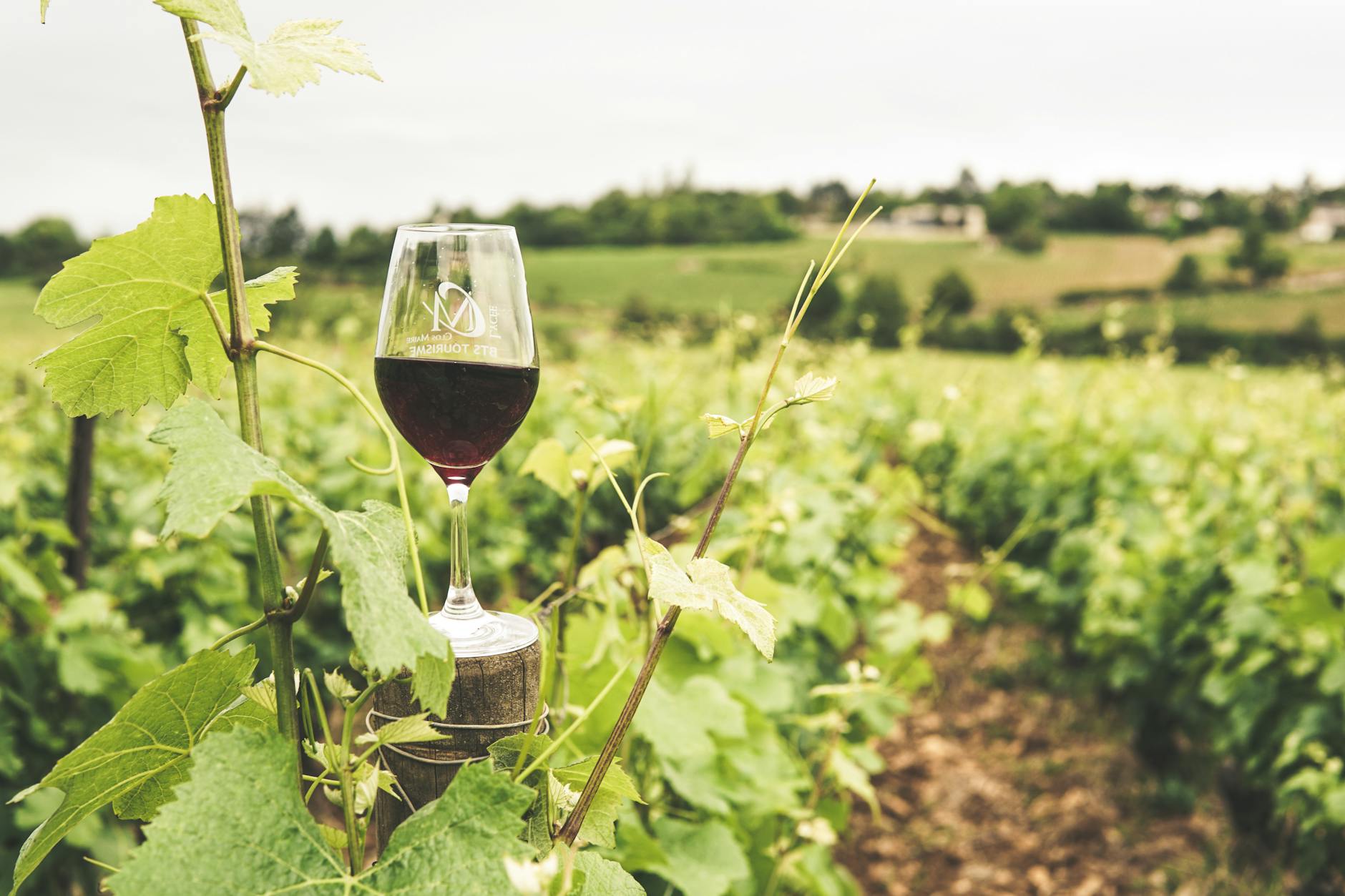
The wine bottled and corked, laid on its side, better still through a passage of time––to be tipped, poured, and consumed… the superb and final product of my root.
Spent and with container cast away, don’t be fooled, my roots continue to abide underneath the trodden way. But above, a leaf, a vine, and a branch or two, sometimes paled, at times brittle, sometimes lithe and green and full of sap, sometimes dried.
My supporting cast beneath the scene witnessed only by bugs, snakes, and spiders. The world can’t see the struggle, the digging deep through rocks and stone, not an ounce of soil to poke into below. This unseen realm of growth, roots pushing, clawing, wriggling, and struggling gives the highest superiority to my fruit. The many times I have cried.
‘Tis gleaned by a Husbandman, the harvest, the fruit of my struggles crushed into a something fresh. A wine complete with new ampule to clothe me in. Laid aside and finished by the passage of time until ready to be tipped and poured and devoured by others.
And I begin again. Subterranean roots pushing, clawing, wriggling through the inflexible ages, struggles to give the highest worth to my fruit,, my precious, for to give to another.
You tried. I tried. You gave up. I gave up. You were the adult. I was the child.
But you did not have the emotional tools or knowhow to figure us out. Neither did I. Nor I with my own.
It is all in the past. I forgive you; you didn’t know what you were doing. You are in heaven; no pain in the memory, no bitterness in the recollection. No resentment to purge from your soul. No, no more.
I’m happy for you. Be happy for me. God has cleansed my sin of hatred for you and carried my wounds under His blood.
See ya later but not soon.
Love (I can say it now),
The daughter you always wanted.
Letter to My Daughter
Dear Daughter, *
You are the daughter I always wanted. When you didn’t act in the ways I was taught a little girl should, I didn’t know what to do. You faced cultural norms my generation never had to endure. I thought it was my job to control you, and shape you into what society said. I was wrong. It took heaven to show me.
It’s all in the past, blurred, for here in my forever home, I have no pain, no bitterness nor resentment of your rejection of me. All is at peace.
I am happy for you. I am happy you stood for yourself and your convictions even though I thought they were convoluted. I secretly admired you for that, but conventions would not allow me to put it on display.
Be happy for me. I too have the festered wounds placed under His blood
Until we meet again in the distant future,
Love, (I also can say it now),
Your Mom, the only mama you had.
PS: Don’t forget to change your underwear every day!
*Yes, this an edited version. I tried to strikethrough the errors in this edit but I could not make it make sense.
When I am not backspacing the black keys with whited letters and deleting an error that I find essential to be wiped out; a letter, word, phrase, an entire sentence, or paragraph, the dust is piling up. I can NEVER bring myself to delete an entire page or document––that is asking too much. I hit save and forever in cyber space, up and into the cloud it floats. It floats until I go searching and demanding its return. Errors float upward and dust floats downward.
I, the industrious error-saver, need to refer to former mistakes. That is how I learn to do better. The problem lies within black font on the white page: How do I know it is indeed a mistake, or just what someone says is? One must ponder many hours for an answer, and I don’t have time. (I have dusting to do.)
A good place to begin trusting is the red squiggly line in the body of text––who can miss it? Or the blue double-underline. Thanks to a nefarious software update, I now must fight the purple line indicating a grammar usage error. Au contraire my friend! I sit before the screen . . . smug and self-righteous knowing this program is not always correct! I wonder what Tolkien, Shakespeare, or Hemingway would have done with this purple monster. I wish to write outside the box, of sentence structure extraordinaire. (Hmm. Maybe I should wait until I’m famous because no one seems to appreciate this flair.)
These colors bring as much anxiety of the returned, red-inked homework in grade school. It is the first clue that someone, rather, someone ‘out there’ believes it to be an error and must be obliterated like the dust off an entertainment center. Whoosh! Gone with the wind.
A clean household requires furniture and objects resting on them be dusted with a puff of ostrich feathers. While performing this sneeze-inducing chore, I pretend that I am deleting phrases, misspellings, dangling modifiers, and comma splices with the flick of my wrist––believe me, there are plenty of both. Yet the feather duster sends it to the cloud and unlike The Cloud, dust returns all on its own––no searching for it finds me!
In my white-glove post-dusting test, a phenomenon had come to light. Perhaps it was the white of the glove trailing through the overlooked dust upon the black table that invoked the revelation: I love black upon white and vice versa!
I love problems that can be solved with black and white precision. I love a white page on the computer screen filled with black text. (Unless it is an unpaid invoice.) I love white vehicles (like my Toyota) trimmed in black. I love my house of white with windows trimmed in black. I love my kitchen cabinets painted white with black pulls on them. I’m guessing that you, dear reader, can guess the color of the countertop.
It is safe to say, “Janet loves white things trimmed with black.” Most theorize it reflects her tendency to interpret life in black and white. Who am I kidding? No one ‘out there’ is sitting posed as the thinker sculpture ruminating the psychology of my idiosyncrasy.
I do tend to take things quite literally. Yet I have learned life is not that way. Everything is gray and covered in dust.”









 theRagingSpoon