Winter weather is fading out, morphing into warm spring nights, and soon to transition to blistering, unending days and nights of the annual summer melt. The rest of the western hemisphere looks forward to the sun after a drab, colorless and lengthy winter. But me, not so much.
I will miss the savoring of the under-the-chin snuggle of the comforter layered atop the weighted blanket knowing with one quick fling of them off my body all warmth will dissipate. I’ll miss the quick tempo of bare feet racing to make the morning latte but stopping first to turn on the heating pad and portable heater, readying for my return. This is my way of saving on the gas bill, no need to heat the entire house when it’s just me occupying less that 10 square feet for an hour or so.
I will miss settling into recliner, covering toes, calves and thighs with the thick blue blanket for added comfort. The act of cupping the latte with both hands to disperse heat through to the bones; yes, I will miss this too.
I will miss lighting candles in the darkened room. Flickering candles lend to a peaceful atmosphere to start the day. Trading fleece bedsheets for cool cotton may have me reaching for the tissue as the removal of one last visage of winter/spring makes me weep.
I love that the dreary sky is bright again, but the sun is my frenemy. Outdoor activities come to a screeching halt and I’m an involuntary hermit once more. As the world turns and people are having fun in the sun, I search for ways to turn my world into fun within the comfort of air conditioning.
Enough lamenting, it’s time to shed the fleece––I know by the time I lay my head on the pillow the night air will be warm and I’ll be glad I did.
The world can’t see my roots growing abysmal and broad, it’s a world witnessed only by bugs, snakes, and spiders. The world can’t see the struggle, the digging deep through rocks and stone, not an ounce soil to poke into below.
Above, a leaf, a vine, and a branch or two, sometimes wilted, sometimes faded, sometimes dry, at times brittle, and at times green, all at the mercy of a wind that blows.
There’s a realm unseen of roots pushing, clawing, wriggling through the inflexible ages, struggles will eventually give the highest worth to my fruit.
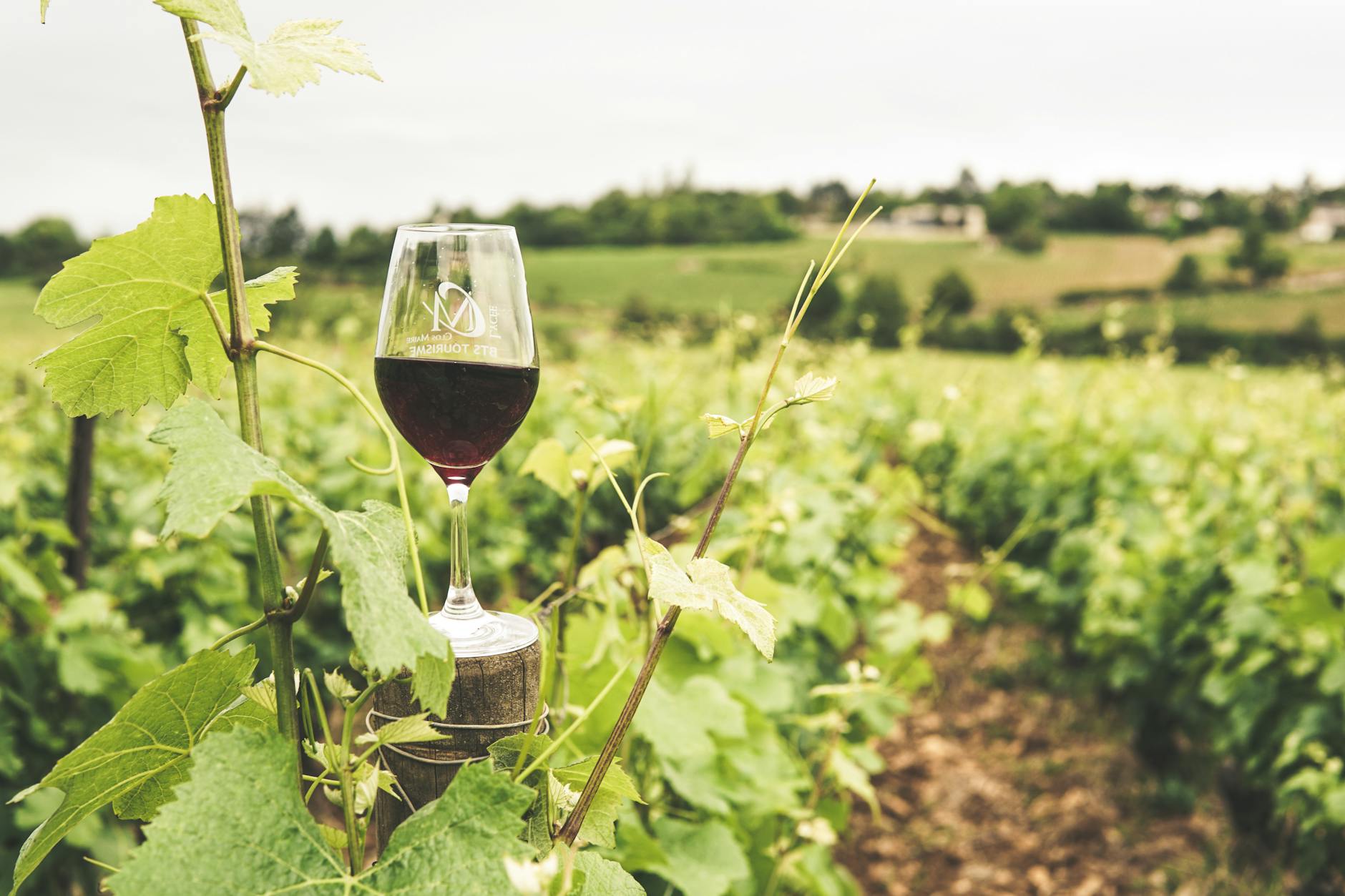
The wine bottled and corked, laid on its side, better still through a passage of time––to be tipped, poured, and consumed… the superb and final product of my root.
Spent and with container cast away, don’t be fooled, my roots continue to abide underneath the trodden way. But above, a leaf, a vine, and a branch or two, sometimes paled, at times brittle, sometimes lithe and green and full of sap, sometimes dried.
My supporting cast beneath the scene witnessed only by bugs, snakes, and spiders. The world can’t see the struggle, the digging deep through rocks and stone, not an ounce of soil to poke into below. This unseen realm of growth, roots pushing, clawing, wriggling, and struggling gives the highest superiority to my fruit. The many times I have cried.
‘Tis gleaned by a Husbandman, the harvest, the fruit of my struggles crushed into a something fresh. A wine complete with new ampule to clothe me in. Laid aside and finished by the passage of time until ready to be tipped and poured and devoured by others.
And I begin again. Subterranean roots pushing, clawing, wriggling through the inflexible ages, struggles to give the highest worth to my fruit,, my precious, for to give to another.
When I am not backspacing the black keys with whited letters and deleting an error that I find essential to be wiped out; a letter, word, phrase, an entire sentence, or paragraph, the dust is piling up. I can NEVER bring myself to delete an entire page or document––that is asking too much. I hit save and forever in cyber space, up and into the cloud it floats. It floats until I go searching and demanding its return. Errors float upward and dust floats downward.
I, the industrious error-saver, need to refer to former mistakes. That is how I learn to do better. The problem lies within black font on the white page: How do I know it is indeed a mistake, or just what someone says is? One must ponder many hours for an answer, and I don’t have time. (I have dusting to do.)
A good place to begin trusting is the red squiggly line in the body of text––who can miss it? Or the blue double-underline. Thanks to a nefarious software update, I now must fight the purple line indicating a grammar usage error. Au contraire my friend! I sit before the screen . . . smug and self-righteous knowing this program is not always correct! I wonder what Tolkien, Shakespeare, or Hemingway would have done with this purple monster. I wish to write outside the box, of sentence structure extraordinaire. (Hmm. Maybe I should wait until I’m famous because no one seems to appreciate this flair.)
These colors bring as much anxiety of the returned, red-inked homework in grade school. It is the first clue that someone, rather, someone ‘out there’ believes it to be an error and must be obliterated like the dust off an entertainment center. Whoosh! Gone with the wind.
A clean household requires furniture and objects resting on them be dusted with a puff of ostrich feathers. While performing this sneeze-inducing chore, I pretend that I am deleting phrases, misspellings, dangling modifiers, and comma splices with the flick of my wrist––believe me, there are plenty of both. Yet the feather duster sends it to the cloud and unlike The Cloud, dust returns all on its own––no searching for it finds me!
In my white-glove post-dusting test, a phenomenon had come to light. Perhaps it was the white of the glove trailing through the overlooked dust upon the black table that invoked the revelation: I love black upon white and vice versa!
I love problems that can be solved with black and white precision. I love a white page on the computer screen filled with black text. (Unless it is an unpaid invoice.) I love white vehicles (like my Toyota) trimmed in black. I love my house of white with windows trimmed in black. I love my kitchen cabinets painted white with black pulls on them. I’m guessing that you, dear reader, can guess the color of the countertop.
It is safe to say, “Janet loves white things trimmed with black.” Most theorize it reflects her tendency to interpret life in black and white. Who am I kidding? No one ‘out there’ is sitting posed as the thinker sculpture ruminating the psychology of my idiosyncrasy.
I do tend to take things quite literally. Yet I have learned life is not that way. Everything is gray and covered in dust.”
It’s true. Mostly. I have a cute little puppy named Jett. That’s short for his registered foo-foo name of Jett Sun’s Joie de Vie Song. Pretentious, pompous, and hard to spell. His registered name reads Jett Sun’s Joie de Vie Song. Joie de Vie is a French phrase meaning Joy of Life.
But I digress.
But all other pets are named Peeve. I was asked to list them once not so long ago but ran out of time and space.
I don’t claim to have an all-time top favorite peeve; about the time I decide to name it as such, another one comes along and pushes it out of place.
For instance, anyone who melts food in Tupperware in the microwave really gets my goat––my goat named Peeve. For a long time that one took home the Blue Ribbon; and a close second was the disappearing lid. Like socks gobbled by the washer, where do lids go? I suspect the washing machine or the garbage bin. There’s a possibility they are in cahoots.
For years these were the only true peeves I thought I owned. Then I encountered my first Costco parking lot. Ugly plastic dishes move aside, parking lots are numeral uno. Peeves shape-shift.
I suppose ye ol’ grammar complaints of the misuse of you’re/ your and the improper use of there/their/there are common peeves, but the most annoying to me is the mispronunciation of important said as impordant. Highly educated people say it all the time. I don’t even enunciate the first t clearly; I just kind of skip it. But I never say the t as d. I don’t know why it bothers me; it just does. Grammar peeves are not just for grammar tyrants.
I know someone who has a peeve named Litrally. I tell her how I interpreted her message litrally and she replies how impordant it is to not do so.
It’s possible that I grate the nerves of listeners when I Oklahoma-fy the washing machine. I never wash the clothes. I warsh the filthy critters.
Other peeves include but not necessarily in order of importance:
Wobbly table legs.
Having to listen to a public one-sided phone conversation. Most people talk extra loud too. UGH!
People who talk in slow-mo.
People who talk in warp-speed. (Yes, call me Goldy Locks).
Slow internet.
People who stare at my face while I talk then ask me to answer a question that I had just explained.
People come to visit you and spend the entire time texting or scrolling through social media.
Speech givers who promise to make a point but go down a gazillion rabbit holes and never return.
People in proximity that sneeze without covering the mouth. YUCK!
Kissing sounds. (shudder)
People who keep walking behind my car while I am backing out of a parking space, sounding off alarms.
People who walk down the middle of parking lot drive space.
When the spacing feature bugs out on my word processor program.
People who have more than 14 pet peeves. They are grumpy gills.
Years ago, I had purchased an audio lecture course for word nerds via Audible. I quit listening for reasons I don’t remember, but it’s most likely a new semester had begun. Now that I am a certified university graduate, I decided to form a new habit of learning one new word each week in 2022.
I do love words; yes, I am a nerd. I just don’t know enough of them to make me sound like a pretentious, and pompous windbag, yet I am willing to learn how to be one. Just kidding. I love how one skilled in language use can string words together, forming into an exquisite and rare-jeweled necklace adorning the page. Like how a blob of paint upon a canvas can be pushed, pulled, and squished around to form an abstract or still life. Or how a musical note layered one upon another can become an enchanting melody transporting me to a third or fourth dimension.
I am also inspired by a long-time friend, a genuine Einstein level of genius who has a vocabulary the size of a real, hard copy, 8” thick Webster’s dictionary: The self-proclaimed and humble Master of None (https://rongiesecke.com/?s=giesecke). In my opinion, you are master of the English vocabulary, whose use of language I admire. (And yes, 8-inch-thick dictionaries really exist. My mother owned one yet was most often used in our family as a toddler’s booster seat at the table.)
After rediscovering and listening to the introductory chapter of the course, I remembered what had attracted me to the lectures; the technique of teaching was finally a process that I could remember a word’s meaning far beyond that of knowing long enough for a test and promptly flushing.
Therefore, what and when I write here is something I cannot take credit for––another’s idea yet put into my own words. That credit belongs solely on the instructor, Kevin Flanigan, PH.D., West Chester University of Pennsylvania. The title of the audio course and the accompanying eBook in PDF format is “Building a Better Vocabulary.”
His method involves 1) defining the word 2) using the word in context 3) breaking down the morphology and/or etymology 4) making connection: the new with what you already know 5) chunking or learning by groups of similar words. Words that are very often used together are collocates and aids memory by learning synonyms that can be connected in meaning.
I have four new words saved to memory: factotum, procrustean, circumspect, and factitious. Following in the footsteps of Prof. Flanigan, I explain my two favorite words from the first four weeks of 2022. These I will remember 50 years from now. (Ask me then.)
Factotum
1. Definition: a factotum is a person who performs many kinds of tasks, or a general servant; a jack-of-all trades.
2. Context: Modern society would not typically use the word factotum to describe a butler, girl- Friday, or a go-fer, but in fact, that is precise meaning of a factotum––one who performs many different types of tasks.
3. Morphology: Latin; fac, make, do + totum; all, of the whole.
Etymology: first used in the 1500s, Martin Luther used factotum in his commentary on Galatians in 1535. (Merriam -Webster dictionary app.)
4. Making connection: take the new word and connect it to what is already known. We know that mothers are nursemaids, cooks, housecleaners, laundresses, chauffeurs, bookkeepers and more. Picture your mother and now you can make a connection of the new word factotum. Moms do a little bit of everything.
5. Chunking: category of words that mean servant, jack-of all-trades, man/girl Friday, personal assistant, or a handyman/woman.
1. Definition: Tending to produce conformity by violent or arbitrary means. According to the Oxford English Dictionary, it means to enforce uniformity or conformity without regard to natural variation or individuality.
2. Context: Many U.S leaders have instituted mandates they equate with constitutional law and enforce by tyrannical means of denying basic human rights such prescription drugs, loss of employment, or denying people to be in public places without proof of receiving a particular injection. Many people view these as being placed on the procrustean bed of leadership by coercing individuals to comply, regardless of personal belief or health status, with the specious argument of keeping every citizen “safe.”
3. Morphology: Procrustean is an adjective derived from Greek mythology of a robber named Procrustes who was known to force victims to lie on a bed and made them fit or by chopping off limbs. Etymology: first known recorded use c.1640s; Procrustes+an (Dictionary.com).
4. Connection: The authoritarian ruler often metes out punishments to young children with procrustean methods such as spanking with a willow tree branch. My personal connection is a memory of an angry mother chasing me around the yard while my calves stung with each strike of a willow branch and an involuntary corresponding yelp. I envision a weeping willow tree and see Procrustes.
5. Chunking with words that mean ruthless, tyrannical conformity, unmerciful, inexorable.
I’m excited to think that by this time next year, I will have 52+ new words to insert into my writing. I suppose at the year’s end that the next challenge is to see how many new words I can use in one blog and be coherent.
We wonder, September, who, what star will sing new,
And who, what star will wax far away.
Your third sapphire day’s star arose shimmering bright
only to apex and implode
into the heavens and dissipated.
The black it left is as bright as the light.
This, too, is to your ode.
Star light, star bright,
We wonder how you are tonight.
A new sapphire day’s star birthed and shines high, distant,
As if this new star would behold
The morning’s glory for an instant,
Our witness that we forget-you-not.
This, too, is to your ode.
September, your eleventh sapphire day’s star
Has darkened halls, the crowds gaze
Ever looking with mouths agape,
Searching beyond black heavens mar;
The blackness in the night stays.
Stars light, stars bright,
We wonder how you are tonight.
Sapphire days, autumn’s equinox, falling foliage,
chilly beginning, sweltering afternoon, asters wilting,
brown and spent. September sapphire days have
forever changed the history of our family lineage.
This, too, is to your ode.
A niece and an uncle’s star away were scurried
To mark the anniversary of my September birth,
Grand-ma-ma’s star flittered away one day after
the thirteenth anniversary of the same. All buried.
This, too, is to your ode.
Stars light, stars bright,
We wonder how you are tonight.
Your third sapphire day’s star arose shimmering bright
only to apex and implode
into the heavens and dissipate.
The black it left is as bright as the light.
This, too, is to your ode.
We wonder, September, who, what star will sing new,
And who, what star will wax far away.
Reviled and cursed is your third sapphire day, September.
Jaydan Anthony, we wonder how you are tonight.
On earth where you mingled, was your glowing ember.
May you light the heavens beyond our sight.
This, too, is to your ode:
I’m posting, in two parts, a short story written as a classroom assignment. This is based on true events that occurred in the ancestral line of my paternal grandmother, my great-great grandparents, John and Eliza Yoakam, who settled in Coos Bay, Oregon in the mid 1850s.
Echoes, Part One
“Turn left here,” Jack yelled.
“No, the map says to turn right,” Holly retorted as she grasped the dead man’s knob on the wheel and turned the large, black Dodge truck with a 5thwheel in tow onto Cape Arago Highway.
“Maybe you’d rather drive,” Holly teased, smiling at her tow-headed husband.
Holly guided the rig toward the RV park near the beach in silence. She thought of the purpose of the trip and hoped she would find answers to nagging questions. Her great-great-grandmother, Eliza Davis Yoakam, and her husband, John, had an experienced a tragedy March 27, 1855, near Coos Bay, Oregon.
The Yoakams had followed the Oregon Trail from Ohio and chose to settle in Empire City in 1852. Eliza, one of the first white female settlers to come to Coos Bay, crossed the nation while pregnant with their eighth child. The Trail had claimed the life of the oldest boy. She gave birth to a girl three days after arriving. Holly tried to imagine how difficult that must have been for her–– alone without her mother’s support. What amazed Holly more was how Eliza had managed to carry on after that fateful night in March, three years later. How does one go on after that?That dogged pioneerdetermination.
Eliza and John lost all five of their daughters during the night, one a babe in her arms. A freak windstorm gusted a large tree upon their makeshift cabin; a branch hit Eliza and the girl she held. Two toddler boys, George and Jasper, survived because they had been tucked in a trundle bed–– and had slept through the ordeal. George was Holly’s great-grandfather.
Eliza Yoakam
She noticed Jack’s fingers tapping near the passenger window. She thought about how much coaxing it had taken for Jack to agree to the trip. He failed to understand her need to see ancestral grounds and thought it morbid to explore the site of tragedy. She bribed him with dinner at the “best Italian restaurant in two states.” Holly couldn’t remember the name, and Jack had teased her how great could the food be if she couldn’t recall its name. She reminded him of the power of Google and said not to worry.
That evening they dined on their traditional beach fare of salami, Swiss cheese, sourdough bread and red wine resting on Holly’s handmade quiltlaid upon the brown-gray sands of Arago Beach, sitting cross-legged and facing each other, against the backdrop of an August sapphire sunset. Milky swirls, aquamarine clouds on hovered close to the setting sun on the Pacific horizon. The sun morphed to a reddish golden globe, a utopian aura casting an array of colors, like rainbow Sherbet, into the clouds as it began its final descent into the ocean waves.
Jack prepared a pit in the sand, piling wood, kindling, wads of paper, and lit the heap with a cigarette lighter. As flares of red flames leapt high, he relaxed and reached for the boxed wine.
“May I?” he asked as he offered to fill Holly’s ‘wine glass,’ their beach term for a red SoHo plastic cup, “You look ravaging in the fire light.”
Holly teased that it was the wine talking, secretly pleased at his compliment, and set out their camp chairs.
“Good idea, Holly, my bones were starting to ache,” he said as he plopped into it.
They discussed the following day’s itinerary and decided to visit all the places on Holly’s list and the next day check off Jack’s list. The special dinner would take place on the eve of the trip home.
They smiled at the antics of the young children and their parents who had walked onto the beach, making S’mores over their small fire. Moments later, a large group of young men, drunken and loutish, caused the family to pack and leave. Holly and Jack looked at each other and without speaking, gathered up their belongings, doused the fire with sand and trudged under the blue-tinged, muted yellow glow of the half-moon to their sanctuary on wheels.
Today’s post is the conclusion to the short essay titled “The Woman in the Wallpaper.” The piece was composed in response to a course requirement at Simpson University.
This true account was originally written in past tense. At the advice of my professor, for the purpose of this blog (and other future publications) it was rewritten in the present tense, as it is presented here.
The Woman in the Wallpaper Part Three
I’m stretched full-length on a soft, pillowy gray couch. My head rests on a small bolster near the arm and my stockinged toes touch the armrest opposite. The room is dimly lit with lavender scented air that lends to the serene, safe atmosphere. Gail, my crisis counselor, is seated in a plush, charcoal colored, high-backed chair opposite me.
I begin the session with the encounter with my mother. I also tell her of the quiet voice that went unheeded that day. I add that I have never mentioned this to anyone before. I tell Gail how I wanted to tell my mother that God had been trying to keep me from being hurt that day. I say that even though I ignored the voice, God still kept breath and life within my tortured body.
I ask a rhetorical question: “Did my mom forget the phone call to come say good-bye as I was not expected to live through that night?” Gail doesn’t answer.
“You didn’t mention any of this to your mother?” she asks.
“No.”
“Why do you think that is?”
“I don’t know. She wouldn’t believe it anyway.” I envision my mother scoffing at the idea that God wanted to keep me safe.
“Why didn’t you get out of the truck?” she questions with a soft and gentle tone yet her steel-gray eyes drill through me like an awl that seems to touch my spine.
My head and shoulders droop, my eyes focus on the fingers of my right hand resting on my lap and clutching a battered tissue as I anguish.
I explain that there were a lot of reasons: the lack of a ride––no one to call to pick me up–– and my desire to spend Independence Day with my love. I tell her how I wanted to avoid my sister, Lisa, who was staying in our house––we had been bickering. I didn’t want to spend my holiday arguing with her. I tell her that’s just how me and Lisa are: we get along great for about two days, then the tensions roil into ugly scenes. It was our third day together and I was fearful things would turn. I lower my voice and add that maybe that’s what I told myself in the moment to justify my staying on the truck.
* * * *
I am like Gilman’s woman in the yellow wallpaper; searching and longing to escape my self-imposed prison. This prison of shame since that blistering-hot July afternoon. This voice of shame––a frenemy carrying the false claim as protectorate of my soul––is squawking in my ear like a parrot belting out mimicry.
Platitudes such as ‘beauty is only skin deep’ and ‘beauty is in the eye of the beholder’ fail. The game continues, still, 19 years of you take it––no you take it. Why should I take on your gift of shame? This is only something that happened to me.
Today’s post is a continuation of an essay written as a university assignment. Every detail is true, except for the name change of my then fiancé, known here as Frank.
The Woman in the Wallpaper––Part Two
Months later, while roaming the aisles of Target Stores, I note a young boy of about 14 years stalking me. I am decked out in all my protective, full-body compression garments, that includes a clear facial mask. (This is medically required that I wear these twenty-three hours a day. The purpose is to help compress the scars from raising, and to reduce bumps and ridges.)
It isn’t a sophisticated style of stalking but spawned by curiosity. I am bone-weary of these encounters. I turn the corner and hide behind the end-cap of bottles of Arrowhead water. I hear the smush-smush of tennis shoes approaching. I jump out and yell BOO. The gloriousness of his terror pervaded, faded, then a squawk, the voice of shame in my ear like a parrot belting out mimicry. Yet I laugh as the boy runs his 100-yard dash. I wonder at my maturity.
Burns scars are external––I can’t hide them– yet they leave a different kind of scar. I see it in the eyes of others. I detect it in the eyes of misogynists especially, who think a woman’s only purpose in life is to provide beauty and slave to their every need. I see it in the soul’s window of other women: a thankful gleam for their retained beauty and a twinkle of superiority. Other times, it is pity that reflects back to me.
They proffer a shiny-gold, gift-wrapped box tied with a pretty pink bow: take this gift and accept the shame enclosed. They say things like “People can tell you used to be a beautiful woman” and “If I were you, I wouldn’t go out in public, I’d be a recluse.”
I accept the gift of shame at my appearance. It is a mill-stone weighted necklace causing my head to hang. I think this talisman will protect me, but I deceive myself. I attempt to return it and rid myself of the weight. We play the you take it––no, you take it–– game.
* * * *
I sit across from Jim at his gray, metal desk, a desk piled with paper; coffee-stained and tinged with pale yellow. Jim, my trainer, is teaching me to box like a butterfly and sting like a bee. He drones on about something––I am multitasking, listening with one ear (my good one) while composing a text message on my gold, iPhone 5. Then he gains my full attention.
“You know, my father-in-law is a burn survivor. I remind him when he is down that this is only something that happened to him. It is not who he is: it doesn’t define him as a person.”
I stare back into the dark, brown eyes, a brown so dark they are nearly black. Images come of an encounter the day before when a fellow burn survivor reproved me for hiding my left hand behind my back. I look down at the now-still fingers of my right hand and think about the mismatched set I now own. The sight of my “lucky fin” fills me with shame.
Yet I sit silent. I don’t tell Jim my mother said God had done this to me because I wasn’t going to church and was living in sin with Frank. I don’t mention how our blue eyes locked––I had my mother’s eyes–– how my own blues eyes were filled with venomous fury at her accusation, nor of my fiery retort.
The internal dialogue runs through my mind like a Dow Jones’ ticker tape: “No, Mom, he didn’t. I’m his child. Would you do this to your child –– would you do this to me?”
But I sit silent remembering the slammed doors, gravel spewing, how I varoomed my black Dodge Ram away.
Me in my mask, circa 2000, and pictured with Frank’s nieces and my daughter, Christa, in the background.
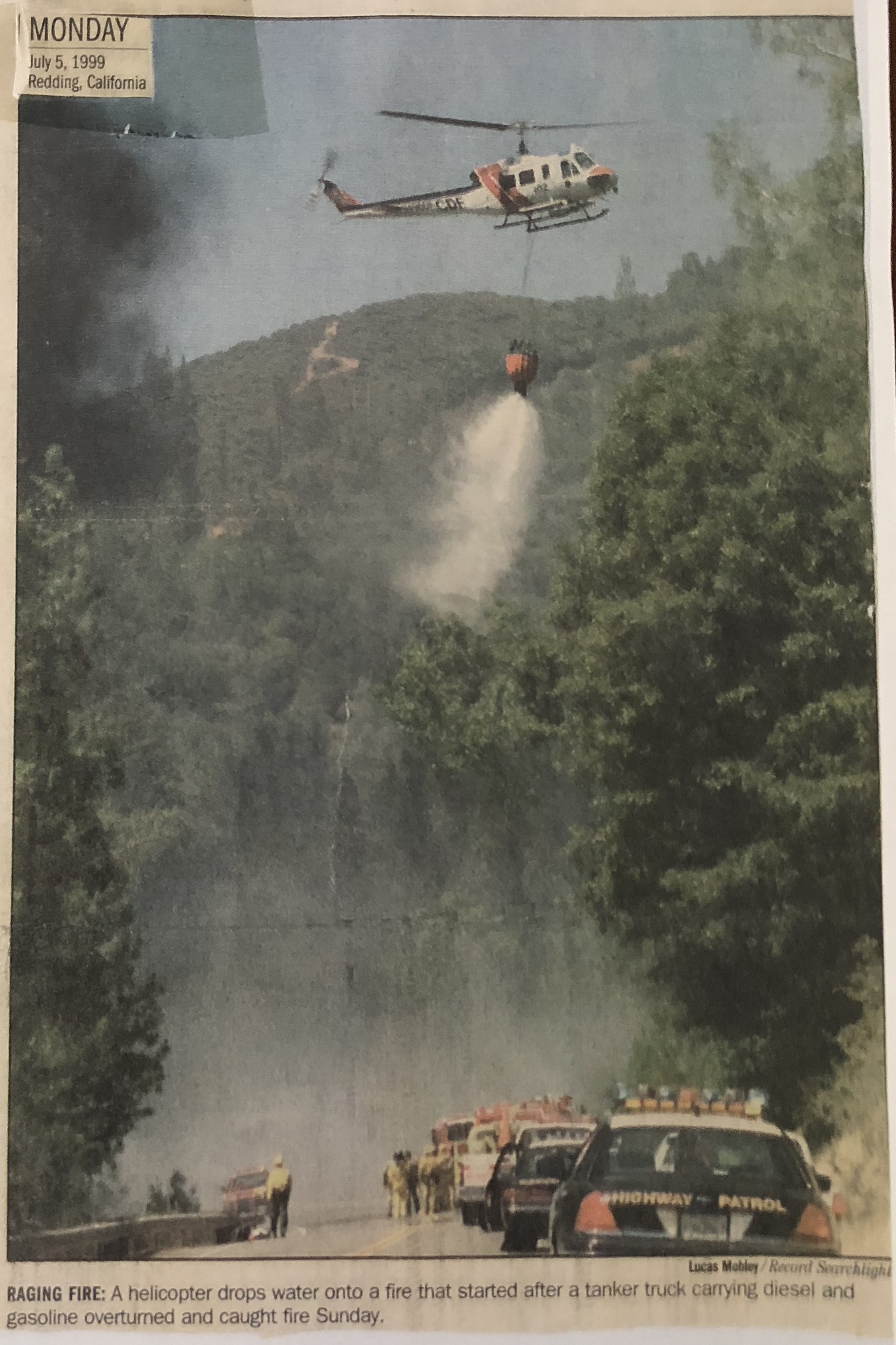
Photo credit: Lucas Mobley/Redding Record Searchlight.
I am posting this autobiographical essay in parts because the original essay was written as such. I wrote this in response to a course requirement in the Advanced Composition course at Simpson University.
Every detail, even the seemingly miniscule, is true to the best of my recollection. The exception is the name change of my fiancé––now and forevermore known as Frank.
The Woman in the Wallpaper ––Part One
The vexing sound of the 3:30 a.m. alarm trumpets through the dark morning air. I groan and pull the duck-down comforter around my chin. My fiancé, Frank, jumps up like a jack-in–the–box and heads into the kitchen. I rouse from a groggy fog and aim for the bathroom. My head throbs and I search through the muddled mist as to why when I remember the festivities of the evening involved beer––a lot of beer. I cherish the sweet, therapeutic bouquet of brewing coffee wafting into the room, ‘go-juice’ that promises to counteract the cobwebby fog.
I stand before the mirror in the dimly-lit room of the porcelain god and begin slathering flesh-colored goo over the source of my identity. I stare at the face in the mirror. Everyone says I am gorgeous, but I don’t believe them. I wonder what I would do if anything happened to my face.
“That’s a weird thought,” I mutter to the reflection as I click off the light and head to the promised land of java.
* * * *
The fuel-tanker’s roaring motor is silenced as Frank brings the truck to a stop at the Whiskeytown Visitor Center. He hops from cab to ground, not bothering to use the two stairsteps, and begins to check the tires––tires carrying nearly 8,000 gallons of gasoline and diesel.
We had met as employees of SST Oil, Inc., a wholesale gasoline and diesel company. We discovered we had attended the same high school, but he was two grades behind me. I knew of him, we knew many of the same people, but we ran in different crowds. I was a band-geek and an aspiring journalist, and he was of the cowboy-party crowd. I remembered seeing his picture in the year book because the class that put the book together thought it would be funny to list his name as a brand of beer, a name similar to his.
At SST Oil, Inc., I work as a bookkeeper, billing fuel stations for gallons of diesel, gasoline, and kerosene delivered by our drivers. Frank is one of our drivers.
I hear the thwack of the tire thumper pounding the tires. Frank whacks each tire––all eighteen of them, a legally required and routine safety check. I have a sudden, all-consuming urge to get out––and stay out. But this urge remains mute and mum.
Frank directs the rig back onto the pavement, West onto Highway 299, a highway buzzing with holiday traffic as we head to the Weaverville BP fuel station. Frank’s conversation takes a weird turn: he talks of recent nightmares of crashing the tanker.
“Well, I hope it’s not today.”
* * * *
I fight through a fog of another kind as I am rousing from a medically-induced coma. I am told I have been under for two months. I fade in and out. Morphine-laden dreams.
Awareness slowly ebbs in to stay. Was it real? Was I the headline: WOMAN HAS EMERGENCY TRACHEOTOMY IN TACO BELL? Pain and tears are the bane of my existence, an existence nearly extinguished.
Nurses bossing, machines beeping, and laughter from the night-shift are the sounds that fill my day. The face on the wall glares at me––we face off––one without blemish, mocking. A red luminescent hand swings around 360 degrees, 1, 440 times a day. I wonder if this ‘hand’ gets as tired as I do from the constant vigil.
I can’t speak or move. I lay in bed with the video playing––what happened; when it happened; and why it happened.
A year later the official report reads that a tire blew out. The blown tire caused the truck and trailer to veer into the ditch. Frank fought to guide it back onto the road, but the weight of the fuel shifted, throwing the truck and trailer into chaos. In the process, the trailer split in two, sparking against pavement. We flipped and rolled across the road into a small ravine. Flames engulfed and surrounded us before the truck stopped twisting, turning.
I lay with pain, tears and memories: hearing Frank say that we’ve got to get out; Frank breaking the windshield with the tire thumper; how he scampered up over the dashboard and out the tiny opening of shattered windshield. A far greater pain pierces and splinters like the windshield at the memory that he bolted and left me to fend for myself.
I replay scene after scene: I think of how I stayed in the midst of bone-penetrating heat, staring at the golden-red flames around me––a moment so surreal––I am starring in a Hollywood film. I replay the panic of knowing I would be burned trying to get to the road; I remember thinking of my grandchildren; thinking that if I was going to die, I would die trying; I recall reciting the mantra– stop, drop and roll– and I remember the rocky ground as I begin crawling army-style up the steep- sided ravine.
The sound of a harsh, double tap at the doorway jolts me back into real time. It’s Nurse Kate. She scolds me for crying. Coming down from morphine accentuates emotions, and I am on the downswing. I say that if you were a burn victim, you’d be crying too.
“You are not a victim. You are a survivor,” she chides.












 theRagingSpoon