On a dark and stormy night, no, I’m joking. It was a hot August night (for reals) when I experienced the phenomena––a life review––my life flashed before my eyes. Granted, it was a like a YouTube Short because I was only 18 years old at the time. It’s a boring name for a fantastical event––a life review. Can’t we come up with something more mysterious? Say like animated appraisal?
At the gloaming, after a laborious day of working in a lumber mill as a ty-up girl, I went to a friend’s house to relax and party a bit. I remember inhaling (unlike Bill Clinton) some wacky tobacky and washed the smokey dry throat with a beer or two. I don’t remember all the sordid details. And I did what all stupid people do; I drove my car the 6 miles to my home. The stigma of driving under the influence in the 1970s wasn’t as it is now, and back-in-the-day no one really gave it much of a second thought unless dire things happened. Shame on us.
All was well until I jerked awake at the wheel approaching the left bend of the exit from the I-5 freeway onto highway 273, exit number 667A. Literally a film of important life events streamed like a Hulu Original. And as stated, it was a short film of only 18 years. It was freaky this occurrence of my life review…er, I mean animated appraisal.
Twenty-three years later I was involved in an accident while riding in a truck and trailer hauling gasoline and diesel, a literal crash and burn scene. The likelihood of survival was slim but there was no life review. According to google scientific studies, this happens when a person thinks they are going to die. Tumbling around in the cab I believed I would die, but no flashes of life passing me by. Later that evening while unconscious I died and had to be revived two or three times, again no review. Just as well because 41 years of life would have a full-feature film.
I no longer drive under the influence of any substance; in case any are wondering.
My little town in far northern California has many now defunct signage––stores out of business, and some for many years. I am tempted many times to grab snapshots of each (most of them) carry childhood memories, but I am not a photographer. At least that is my excuse for failing to do so.
This sign of Gene’s Hamburgers has special memories of grammar school days with clothes shopping trips to the “big city” of Redding, California. We lived in the country between two tiny towns with few people about 20 miles south. My parents were frugal, pragmatic people. We rarely ate meals outside our home. We raised our own beef and had a large garden; the logic was why pay for food when we have plenty at home?
The rare exception was a trip to Redding for items not found in our local stores, such as the awful oxford black and white shoes we girls we forced to wear for the first few years of school. I would say God-awful but why should he get all the blame? But I digress.
Redding trips were exiting because cheeseburgers, fries, and Coca-Colas were on the lunch menu. And Gene’s Hamburgers was the family favorite. For decades Genes was the local social hangout for car enthusiasts, but today it has been razed including the sign. The lot sits empty and forlorn.
One the last meals I had with my grandmother was from this hamburger joint. I’m thankful I had the foresight to snap this pic years ago when I first heard of the plans to close the place.
There once was a little girl who had the nursery-rhyme curl in the middle of her forehead. Country folk like to call it a cowlick, named after the way a swirling pattern is fashioned when a cow licks the hair of her calf. But on humans it refers to a strand of hair that stands up or lies at an angle at odds with the rest of the hair. Little Girl was made with two––one on her forehead and one on the crown of her head.
Heading down the lane to “home”. Photo taken in front of the former G.F. Spoon home.
Little Girl lived with her parents at the end of a dirt road; a road that seemed endless to a small girl. Her father’s parents, Grandma and Grandpa Spoon, lived at the mid-way point so that she passed their house when walking up or down the lane. Walking ‘up the lane’ meant going to the paved road that led into town. Walking ‘down the lane’ meant going home.
Her adventures of riding the school bus began at an early age. The bus was a big caterpillar looking mustard-colored machine that gobbled up kids early in the morning and carried them away to places where they were taught all sorts of things. The best thing about this bus was it brought them back to the end of the lane and spit them out in the afternoons.
Little Girl knew how to read fluently at four years old, so she skipped kindergarten and started the first grade at four, turning five years old three weeks later. She was able to read so young because her grandma, the one who lived up the lane, taught her. In fact, her Grandma Spoon taught most all her grandchildren to read for she was a retired schoolteacher.
On non-school days Little Girl walked up the lane to visit her mother’s parents, who also lived in the neighborhood. She visited the Watkins’ home often because she liked her grandma and had hopes of being given buttered toast covered with sugar. It was a secret treat just for Little Girl whose mother never allowed such a thing. Two uncles and one auntie also lived with Grandma and Grandpa Watkins, but Grandpa was rarely home because he worked in the woods far away. The uncles played guitars and Little Girl danced with her auntie to the catchy tunes. Sometimes she didn’t dance at all and watched Auntie twist to the music on her Twister Board. The Twist was all the rage in that day.
A visit to the Watkins’ home meant walking up the lane just past the Spoon home. The two homes were separated by a wide pasture and was catty-corner to the Spoons. So, she had to go under a barbed-wire fence and walk the pasture because she wasn’t allowed to walk on the paved road. The problem was the field was home to many cows and bulls and Little Girl was afraid of cattle. She always looked two or three times to be sure they were far away before risking being poked by the barbed wire fence while entering the field.
She hurried along the way looking over her shoulder to be sure no beast had her in their sights until she was safely over the wood fence into the Watkins’ yard. She loved being able to visit both sets of grandparents all by herself, no adult to scold her for this or that or anything at all. Or any pesky siblings to bother her.
After every school day, school bus #81 dropped her and her older brother to walk down the long lane to home. Their baby sister stayed home because she was just that, a baby. And babies didn’t go to school or ride busses.
A row of mailboxes sat on the edge of the dirt road ending a few feet before the paved highway perpendicular to the dirt road. Little Girl always opened the door of the largest mailbox first and snatched the stamped envelopes addressed to Mr. and Mrs. G.F. Spoon. Her brother never interfered, and she never knew why he was not interested in this fun chore.
It was fun to Little Girl because Grandma rewarded her with a dill pickle. Little Girl was well known for her love of dill pickles, but her mother never bought them because her father, nor her brother liked them. Some days Grandma was out of dill and substituted sweet or bread and butter. Little Girl didn’t like these pickles as much, but she still ate them.
If the weather was good, Grandma would be sitting in her rocking chair on the porch. She would ask if Little Girl was a good mailman or a bad one. She never really knew what she was but always answered “good.”
Sometimes Grandpa joined them but most times he was in his workshop behind the house. The shop was built by the old man out of blackened railroad ties. Many stood slightly crooked and off kilter. Little Girl learned late in life that the reason the thick square boards were blackened was because her father, in his early 20s, had accidently set fire to them. Yet he never confessed to Grandpa Spoon.
Grandpa Spoon was a small man whose boot size was only 7.5, small for the average man and was 5 foot 9 inches or so tall, or so they said. His stooped shoulders and wrinkly lines on his bespectacled face made him look shorter. But Grandma was robust making her appear slightly taller than her husband. He wasn’t as friendly to Little Girl as Grandma, so she didn’t seek him out if he was absent.
Little Girl’s home was about 1/8 mile from the elder’s Spoon Ranch, as it was called. She loved talking with her grandma, because Grandma had been a substitute teacher in nearly every school in Shasta County, California, and beyond. She had lots of stories to tell––stories about the old days.
One day she learned how Grandma earned her teaching credentials: She and her five children at the time stayed camped out in a tent in Mt. Shasta, California. She attended classes while the oldest children watched the younger in the campground. Sometimes Grandma took a child to school with her. She did this for about 6 weeks! Little Girl was impressed at the fortitude and courage Grandma demonstrated. Even at five years old she recognized her grandma as a free thinker, a woman ahead of her time. In that era, most married women did not work on a job: they stayed home caring for the children, cooking, and cleaning while the husband was employed.
Little Girl’s favorite story was when Grandma went to work teaching at a school in the Jelly’s Ferry Road area in northern California. Her youngest baby at the time, Daisy Bell, just a few months old was put on the teacher’s desk to nap. Before Grandma knew it the baby rolled aside right off that desk! She had been wrapped up so tight that the unravelling of the blanket stopped the babe from hitting the floor with full force.
There was a day, May 25, 1966, when Little Girl got off the bus to find flashing lights of an ambulance parked in the road in front of the Spoon Ranch house. She forgot about the mail, she forgot about being a good or bad mailman, and even forgot about the dill pickle. She ran to the house, but her father met her and her brother on the road in front of the house and were told not to stop but to go home to Mama. He only said Grandpa was sick and needed to go to the hospital. No one told her grandpa was already gone before the ambulance got there. He had keeled over with a stroke. Just like that––at the snap of a finger––talking one second and gone the next.
Little Girl was distressed that grandma was all alone and asked to spend the night to care for her. She was allowed and slept on Grandma’s couch for the next several nights. Each morning, she made hotcakes for Grandma who insisted they were not called pancakes, but hotcakes!
The old women still drank water from a dipper filled from the kitchen faucet instead of from a glass. She never explained why she did this, but Little Girl perceived it went back to the days of drawing a bucket of water from a well, long before indoor plumbing and kitchen faucets were installed in homes.
One time when Little Girl was washing a drinking glass she had used, Grandma Spoon told her with an air of superiority, “people always wash the bottom of the glass when they should be washing the rim because that’s where the germs are!” To this very day Little Girl can’t wash a glass without hearing that voice in her head to wash the rim, where the germs are.
As Little Girl was still learning to make a hotcake taste good, her grandmother sat at the table patiently waiting. One morning she instructed Little Girl to do all things in the name of Jesus. If you can’t do it in His name, you shouldn’t be doing it. (Little Girl wondered if that would help make the perfect hotcake.) She never forgot this advice but didn’t always adhere to the guidance.
After several nights keeping guard of her beloved grandma, she awoke one morning to find an extra blanket upon her. Little Girl didn’t remember crying in the night, but Grandma got up to cover her. Little Girl felt she had failed. She was supposed to take care of grandma, not be cared for. But Little Girl was only 9 years old and didn’t realize a lot of things. That was Little Girl’s last night at the Spoon house. The adults decided one of Grandma Spoon’s daughters should take the job until a professional nurse could be hired.
Three and one-half years later, just after midnight of the first full day of Little Girl being 12 years old, her grandmother, her teacher, and spiritual advisor, passed on to her heavenly home.
Little Girl learned long after Grandma Spoon’s passing, when Little Girl’s little girl had a little girl, that Grandma had been a postmaster in a tiny town named after her: the town of Stacy, California, in honor of Mary Stacy Joella Yoakam Spoon, Postmaster.
Today’s post is a continuation of an essay written as a university assignment. Every detail is true, except for the name change of my then fiancé, known here as Frank.
The Woman in the Wallpaper––Part Two
Months later, while roaming the aisles of Target Stores, I note a young boy of about 14 years stalking me. I am decked out in all my protective, full-body compression garments, that includes a clear facial mask. (This is medically required that I wear these twenty-three hours a day. The purpose is to help compress the scars from raising, and to reduce bumps and ridges.)
It isn’t a sophisticated style of stalking but spawned by curiosity. I am bone-weary of these encounters. I turn the corner and hide behind the end-cap of bottles of Arrowhead water. I hear the smush-smush of tennis shoes approaching. I jump out and yell BOO. The gloriousness of his terror pervaded, faded, then a squawk, the voice of shame in my ear like a parrot belting out mimicry. Yet I laugh as the boy runs his 100-yard dash. I wonder at my maturity.
Burns scars are external––I can’t hide them– yet they leave a different kind of scar. I see it in the eyes of others. I detect it in the eyes of misogynists especially, who think a woman’s only purpose in life is to provide beauty and slave to their every need. I see it in the soul’s window of other women: a thankful gleam for their retained beauty and a twinkle of superiority. Other times, it is pity that reflects back to me.
They proffer a shiny-gold, gift-wrapped box tied with a pretty pink bow: take this gift and accept the shame enclosed. They say things like “People can tell you used to be a beautiful woman” and “If I were you, I wouldn’t go out in public, I’d be a recluse.”
I accept the gift of shame at my appearance. It is a mill-stone weighted necklace causing my head to hang. I think this talisman will protect me, but I deceive myself. I attempt to return it and rid myself of the weight. We play the you take it––no, you take it–– game.
* * * *
I sit across from Jim at his gray, metal desk, a desk piled with paper; coffee-stained and tinged with pale yellow. Jim, my trainer, is teaching me to box like a butterfly and sting like a bee. He drones on about something––I am multitasking, listening with one ear (my good one) while composing a text message on my gold, iPhone 5. Then he gains my full attention.
“You know, my father-in-law is a burn survivor. I remind him when he is down that this is only something that happened to him. It is not who he is: it doesn’t define him as a person.”
I stare back into the dark, brown eyes, a brown so dark they are nearly black. Images come of an encounter the day before when a fellow burn survivor reproved me for hiding my left hand behind my back. I look down at the now-still fingers of my right hand and think about the mismatched set I now own. The sight of my “lucky fin” fills me with shame.
Yet I sit silent. I don’t tell Jim my mother said God had done this to me because I wasn’t going to church and was living in sin with Frank. I don’t mention how our blue eyes locked––I had my mother’s eyes–– how my own blues eyes were filled with venomous fury at her accusation, nor of my fiery retort.
The internal dialogue runs through my mind like a Dow Jones’ ticker tape: “No, Mom, he didn’t. I’m his child. Would you do this to your child –– would you do this to me?”
But I sit silent remembering the slammed doors, gravel spewing, how I varoomed my black Dodge Ram away.
Me in my mask, circa 2000, and pictured with Frank’s nieces and my daughter, Christa, in the background.
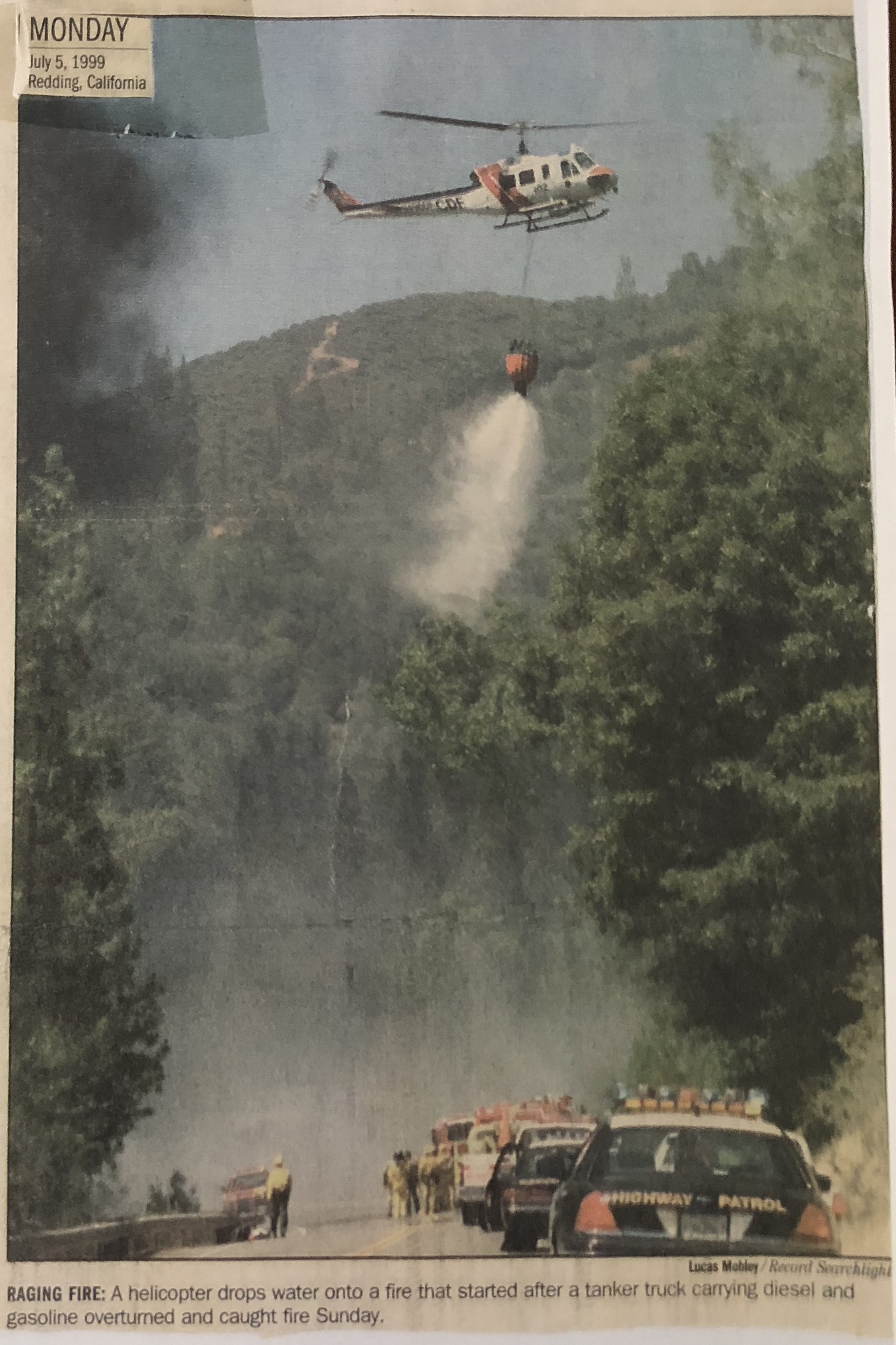
Photo credit: Lucas Mobley/Redding Record Searchlight.
I am posting this autobiographical essay in parts because the original essay was written as such. I wrote this in response to a course requirement in the Advanced Composition course at Simpson University.
Every detail, even the seemingly miniscule, is true to the best of my recollection. The exception is the name change of my fiancé––now and forevermore known as Frank.
The Woman in the Wallpaper ––Part One
The vexing sound of the 3:30 a.m. alarm trumpets through the dark morning air. I groan and pull the duck-down comforter around my chin. My fiancé, Frank, jumps up like a jack-in–the–box and heads into the kitchen. I rouse from a groggy fog and aim for the bathroom. My head throbs and I search through the muddled mist as to why when I remember the festivities of the evening involved beer––a lot of beer. I cherish the sweet, therapeutic bouquet of brewing coffee wafting into the room, ‘go-juice’ that promises to counteract the cobwebby fog.
I stand before the mirror in the dimly-lit room of the porcelain god and begin slathering flesh-colored goo over the source of my identity. I stare at the face in the mirror. Everyone says I am gorgeous, but I don’t believe them. I wonder what I would do if anything happened to my face.
“That’s a weird thought,” I mutter to the reflection as I click off the light and head to the promised land of java.
* * * *
The fuel-tanker’s roaring motor is silenced as Frank brings the truck to a stop at the Whiskeytown Visitor Center. He hops from cab to ground, not bothering to use the two stairsteps, and begins to check the tires––tires carrying nearly 8,000 gallons of gasoline and diesel.
We had met as employees of SST Oil, Inc., a wholesale gasoline and diesel company. We discovered we had attended the same high school, but he was two grades behind me. I knew of him, we knew many of the same people, but we ran in different crowds. I was a band-geek and an aspiring journalist, and he was of the cowboy-party crowd. I remembered seeing his picture in the year book because the class that put the book together thought it would be funny to list his name as a brand of beer, a name similar to his.
At SST Oil, Inc., I work as a bookkeeper, billing fuel stations for gallons of diesel, gasoline, and kerosene delivered by our drivers. Frank is one of our drivers.
I hear the thwack of the tire thumper pounding the tires. Frank whacks each tire––all eighteen of them, a legally required and routine safety check. I have a sudden, all-consuming urge to get out––and stay out. But this urge remains mute and mum.
Frank directs the rig back onto the pavement, West onto Highway 299, a highway buzzing with holiday traffic as we head to the Weaverville BP fuel station. Frank’s conversation takes a weird turn: he talks of recent nightmares of crashing the tanker.
“Well, I hope it’s not today.”
* * * *
I fight through a fog of another kind as I am rousing from a medically-induced coma. I am told I have been under for two months. I fade in and out. Morphine-laden dreams.
Awareness slowly ebbs in to stay. Was it real? Was I the headline: WOMAN HAS EMERGENCY TRACHEOTOMY IN TACO BELL? Pain and tears are the bane of my existence, an existence nearly extinguished.
Nurses bossing, machines beeping, and laughter from the night-shift are the sounds that fill my day. The face on the wall glares at me––we face off––one without blemish, mocking. A red luminescent hand swings around 360 degrees, 1, 440 times a day. I wonder if this ‘hand’ gets as tired as I do from the constant vigil.
I can’t speak or move. I lay in bed with the video playing––what happened; when it happened; and why it happened.
A year later the official report reads that a tire blew out. The blown tire caused the truck and trailer to veer into the ditch. Frank fought to guide it back onto the road, but the weight of the fuel shifted, throwing the truck and trailer into chaos. In the process, the trailer split in two, sparking against pavement. We flipped and rolled across the road into a small ravine. Flames engulfed and surrounded us before the truck stopped twisting, turning.
I lay with pain, tears and memories: hearing Frank say that we’ve got to get out; Frank breaking the windshield with the tire thumper; how he scampered up over the dashboard and out the tiny opening of shattered windshield. A far greater pain pierces and splinters like the windshield at the memory that he bolted and left me to fend for myself.
I replay scene after scene: I think of how I stayed in the midst of bone-penetrating heat, staring at the golden-red flames around me––a moment so surreal––I am starring in a Hollywood film. I replay the panic of knowing I would be burned trying to get to the road; I remember thinking of my grandchildren; thinking that if I was going to die, I would die trying; I recall reciting the mantra– stop, drop and roll– and I remember the rocky ground as I begin crawling army-style up the steep- sided ravine.
The sound of a harsh, double tap at the doorway jolts me back into real time. It’s Nurse Kate. She scolds me for crying. Coming down from morphine accentuates emotions, and I am on the downswing. I say that if you were a burn victim, you’d be crying too.
“You are not a victim. You are a survivor,” she chides.
I’m back after a hiatus full of funk, junk and many deliveries to the local transfer station, formerly referred to as THE DUMP in childhood days.
We mark our days by events. Having surpassed the 19th anniversary of the worst day of my life, I’ve been in a funk, a funk dark and deep enough that writing didn’t seem to bring joy.
In an attempt to prod my way out, I’ve been clawing and pawing through useless junk in my home.
Sorting through things I once valued, I find the hardest part is making decisions: stay or go? Sometimes it’s really tough.
Asking myself two questions helps speed the process and eliminates much hedging: “Has this thing served me?” and if the answer is in the affirmative I ask: “Will this continue to be beneficial to me on a regular basis?”
Murphy’s Law says that the thing I stored for 15 years and never used, will be the exact item I need in two weeks’ time. Such is life.
The new rule is that if I bring something new into my home, something old has to go.
Paralleling this physical activity, I’ve encountered meaningless emotions, thoughts, attitudes, perspectives and memories tied to these things. I am actively exposing the crap to daylight, dusting them off and asking the same two questions above. These things haven’t always served me well. Thus, the rule applies: bringing a new (positive and edifying) thought, emotion, etc., into my soul requires the old must go.
This requires active, purposeful and constant care. I suspect it’s going to take a lifetime. A healthy soul is a happy soul.
Oh, the faces I make while moving through the events of an ordinary day. Something tells me I am not alone.
My trail-walking face: smile, wave, greet passers-by with a cheery “Good Morning.”
My traffic face: scowl, growl, and glare with shoulders scrunched up to my ears and hands raised, outspread to each side, greet fellow drivers with a screech “What the hay are you thinking?”
Your mother prepared a wonderful tribute
to her beloved son:
I ‘ve enclosed a note to you––
You didn’t know how much
you would be missed.
You didn’t know of our unfailing love for you.
Your mother, your father,
Your brothers and your sisters,
Your Gram and many others, too.
This abyss.
Every day
We think of you––
Of what could have,
What should have,
What would have,
Been.
This abyss.
I flew in a jet plane to see you
The day you were born.
Your sweet, tiny face shadowed
With my father’s image.
You were three weeks old
When you took your first jet ride
1,000 miles to your Gram’s house.
You were the tiniest of visitors.
They called you Jay-Jay the Jet Plane.
I called you Cricket.
The Cricket and the Frog (photo credit: Jessica Martinusen)
I could not see you, but I could hear your teeny voice.
It was in a stupid moment, a cursed choice.
that will not allow us your face to see.
Let us hear you.
Many thoughts are of you this day––
Of what could have,
What should have,
What would have,
Been.
I am posting an excerpt from writings I began several months ago. It is a true story, written in the present tense, of life after burns, yet the story in its entirety does tells of the accident, subsequent hospitalization and such. The title 1000 Deaths is a temporary, working title at this point.
Dr. Greenhalgh, my burn doctor next to me in August 2012 at UCDavis Medical Center, Sacramento, California.
1000 Deaths
I stand proudly before the oven in our newly constructed house. We’ve moved into it three days ago and this is our first home-cooked meal––roast beef with roasted carrots and red potatoes. I secretly gloat at the memory that as a licensed Real Estate agent, I earned a commission for buying my own home.
I open the door for a peek at the goods and I wheeze from the heat-blast, and I’m shaken and tossed. Like a soldier with PTSD, I am standing in the blaze screaming for Frank.* He tells me my hair is smoldering, but it is my hand I notice, melted and deformed.
Someone yells, and I about-face to find off-duty firefighters suiting-up––but they stop, frozen. The fuel tanker explodes, and they shed their gear. They tell me to lie down on the sizzling asphalt.
Once there, they douse me with saline. I am howling, animal-like for more. They say they are out and I plead for water. But they say they can’t because water might cause the burns to become infected. I yell that I don’t care.
I see the treetops burning as I lie on the asphalt, waiting for my seven-winged bird. I’m reassured the Medi-Vac helicopter is on its way and I hope. Black smoke floats higher and higher above the flames.
I see Frank on the ground to my right. He has arms in the air and my stomach churns at the sight of the skin falling from his forearms. Rows of vehicles line the road, watching, waiting for the danger to clear, gawking at the unlucky ones. I turn my face to the left and a camera is inches away. Behind the camera, a woman is crouching and flashes light the air. I yell for her to stop. How dare she?
And I begin to yowl.
The sound of Frank’s footsteps on the hardwood floor and his worried cry catapults me into my world of roast beef, carrots and potatoes.
“What happened?” he demands, “Are you alright?’
It’s nothing dear, wash up, and please, set the table. Dinner is almost ready.” I turn to smile at him then turn away and wipe the tears away with a dish towel.










 theRagingSpoon