Mom surprised us all by going before Dad. 1,778 days later, he followed her.
In the intervening years Dad was capable and willing of doing for himself. But the 64-year relationship was built upon Mom doing all things indoors and Dad conquered outdoor chores on the small ranch. It fell upon a couple of family members to fill the gaps of cooking meals, a bit of banking, and other oddball tasks. For me, the oldest daughter, it was more about being with him as well as stocking the fridge with casseroles and desserts.
It meant Sunday afternoon visits after church. It was a short drive of about 20 miles to the childhood property I grew up on. It was still home to me despite Mom not being around.
One week necessitated a midweek trip to dear ole’ Dad’s. He needed my help with some banking back in my little town. Coincidentally, the tune “My Little Town” (Simon & Garfunkel) repeated in splendid reverie as I turned onto his little lane. I crooned the lyrics of the chorus, “nothing but the dead of night back in my little town,” and for reasons unknown curiosity compelled me to pull over and Google the lyrics to the full song.
I was stupefied to learn that for the past umpteen years I’ve been belting out incorrect words. According to lyrics.com, the correct lyrics are “nothing but the dead and dying back in my little town.” My bad.
At the time, dead and dying seemed to be more appropriate at that time; from 2016 to 2018 my little town had lost my mother and three aunties, two of whom I was especially close to. Dead and dying spoke
The lyric of the song seems to imply nothing productive comes from their little town whereas my little town has lost four bastions of strength, grace, faith and character.
I prefer to keep my version. Maybe it is born from habit of many years. Maybe it’s plain stubbornness––I’ll keep on keening “nothing but the dead of night.”
The Sunday afternoon and mid-week visits have ceased. Although the property now belongs to me another family lives there. When my outings take me to the little ranch at the end of the lane, it doesn’t feel like home, making the ancient adage true: you can’t go home again.
Gosh darn it––I must take my leave before this earworm leaves me in a puddle. (Insert humming sounds.)
My little town in far northern California has many now defunct signage––stores out of business, and some for many years. I am tempted many times to grab snapshots of each (most of them) carry childhood memories, but I am not a photographer. At least that is my excuse for failing to do so.
This sign of Gene’s Hamburgers has special memories of grammar school days with clothes shopping trips to the “big city” of Redding, California. We lived in the country between two tiny towns with few people about 20 miles south. My parents were frugal, pragmatic people. We rarely ate meals outside our home. We raised our own beef and had a large garden; the logic was why pay for food when we have plenty at home?
The rare exception was a trip to Redding for items not found in our local stores, such as the awful oxford black and white shoes we girls we forced to wear for the first few years of school. I would say God-awful but why should he get all the blame? But I digress.
Redding trips were exiting because cheeseburgers, fries, and Coca-Colas were on the lunch menu. And Gene’s Hamburgers was the family favorite. For decades Genes was the local social hangout for car enthusiasts, but today it has been razed including the sign. The lot sits empty and forlorn.
One the last meals I had with my grandmother was from this hamburger joint. I’m thankful I had the foresight to snap this pic years ago when I first heard of the plans to close the place.
There once was a little girl who had the nursery-rhyme curl in the middle of her forehead. Country folk like to call it a cowlick, named after the way a swirling pattern is fashioned when a cow licks the hair of her calf. But on humans it refers to a strand of hair that stands up or lies at an angle at odds with the rest of the hair. Little Girl was made with two––one on her forehead and one on the crown of her head.
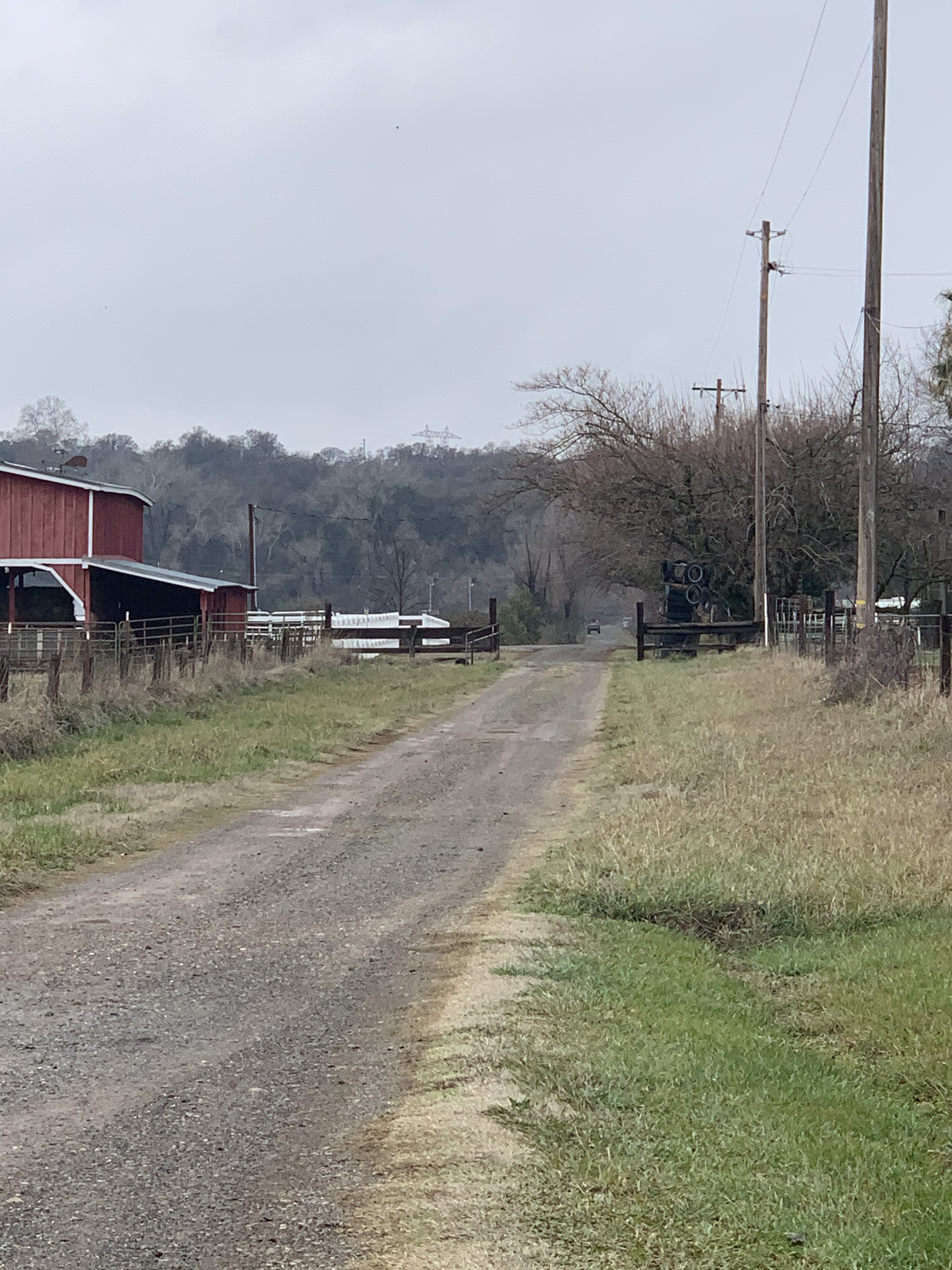
Heading down the lane to “home”. Photo taken in front of the former G.F. Spoon home.
Little Girl lived with her parents at the end of a dirt road; a road that seemed endless to a small girl. Her father’s parents, Grandma and Grandpa Spoon, lived at the mid-way point so that she passed their house when walking up or down the lane. Walking ‘up the lane’ meant going to the paved road that led into town. Walking ‘down the lane’ meant going home.
Her adventures of riding the school bus began at an early age. The bus was a big caterpillar looking mustard-colored machine that gobbled up kids early in the morning and carried them away to places where they were taught all sorts of things. The best thing about this bus was it brought them back to the end of the lane and spit them out in the afternoons.
Little Girl knew how to read fluently at four years old, so she skipped kindergarten and started the first grade at four, turning five years old three weeks later. She was able to read so young because her grandma, the one who lived up the lane, taught her. In fact, her Grandma Spoon taught most all her grandchildren to read for she was a retired schoolteacher.
On non-school days Little Girl walked up the lane to visit her mother’s parents, who also lived in the neighborhood. She visited the Watkins’ home often because she liked her grandma and had hopes of being given buttered toast covered with sugar. It was a secret treat just for Little Girl whose mother never allowed such a thing. Two uncles and one auntie also lived with Grandma and Grandpa Watkins, but Grandpa was rarely home because he worked in the woods far away. The uncles played guitars and Little Girl danced with her auntie to the catchy tunes. Sometimes she didn’t dance at all and watched Auntie twist to the music on her Twister Board. The Twist was all the rage in that day.
A visit to the Watkins’ home meant walking up the lane just past the Spoon home. The two homes were separated by a wide pasture and was catty-corner to the Spoons. So, she had to go under a barbed-wire fence and walk the pasture because she wasn’t allowed to walk on the paved road. The problem was the field was home to many cows and bulls and Little Girl was afraid of cattle. She always looked two or three times to be sure they were far away before risking being poked by the barbed wire fence while entering the field.
She hurried along the way looking over her shoulder to be sure no beast had her in their sights until she was safely over the wood fence into the Watkins’ yard. She loved being able to visit both sets of grandparents all by herself, no adult to scold her for this or that or anything at all. Or any pesky siblings to bother her.
After every school day, school bus #81 dropped her and her older brother to walk down the long lane to home. Their baby sister stayed home because she was just that, a baby. And babies didn’t go to school or ride busses.
A row of mailboxes sat on the edge of the dirt road ending a few feet before the paved highway perpendicular to the dirt road. Little Girl always opened the door of the largest mailbox first and snatched the stamped envelopes addressed to Mr. and Mrs. G.F. Spoon. Her brother never interfered, and she never knew why he was not interested in this fun chore.
It was fun to Little Girl because Grandma rewarded her with a dill pickle. Little Girl was well known for her love of dill pickles, but her mother never bought them because her father, nor her brother liked them. Some days Grandma was out of dill and substituted sweet or bread and butter. Little Girl didn’t like these pickles as much, but she still ate them.
If the weather was good, Grandma would be sitting in her rocking chair on the porch. She would ask if Little Girl was a good mailman or a bad one. She never really knew what she was but always answered “good.”
Sometimes Grandpa joined them but most times he was in his workshop behind the house. The shop was built by the old man out of blackened railroad ties. Many stood slightly crooked and off kilter. Little Girl learned late in life that the reason the thick square boards were blackened was because her father, in his early 20s, had accidently set fire to them. Yet he never confessed to Grandpa Spoon.
Grandpa Spoon was a small man whose boot size was only 7.5, small for the average man and was 5 foot 9 inches or so tall, or so they said. His stooped shoulders and wrinkly lines on his bespectacled face made him look shorter. But Grandma was robust making her appear slightly taller than her husband. He wasn’t as friendly to Little Girl as Grandma, so she didn’t seek him out if he was absent.
Little Girl’s home was about 1/8 mile from the elder’s Spoon Ranch, as it was called. She loved talking with her grandma, because Grandma had been a substitute teacher in nearly every school in Shasta County, California, and beyond. She had lots of stories to tell––stories about the old days.
One day she learned how Grandma earned her teaching credentials: She and her five children at the time stayed camped out in a tent in Mt. Shasta, California. She attended classes while the oldest children watched the younger in the campground. Sometimes Grandma took a child to school with her. She did this for about 6 weeks! Little Girl was impressed at the fortitude and courage Grandma demonstrated. Even at five years old she recognized her grandma as a free thinker, a woman ahead of her time. In that era, most married women did not work on a job: they stayed home caring for the children, cooking, and cleaning while the husband was employed.
Little Girl’s favorite story was when Grandma went to work teaching at a school in the Jelly’s Ferry Road area in northern California. Her youngest baby at the time, Daisy Bell, just a few months old was put on the teacher’s desk to nap. Before Grandma knew it the baby rolled aside right off that desk! She had been wrapped up so tight that the unravelling of the blanket stopped the babe from hitting the floor with full force.
There was a day, May 25, 1966, when Little Girl got off the bus to find flashing lights of an ambulance parked in the road in front of the Spoon Ranch house. She forgot about the mail, she forgot about being a good or bad mailman, and even forgot about the dill pickle. She ran to the house, but her father met her and her brother on the road in front of the house and were told not to stop but to go home to Mama. He only said Grandpa was sick and needed to go to the hospital. No one told her grandpa was already gone before the ambulance got there. He had keeled over with a stroke. Just like that––at the snap of a finger––talking one second and gone the next.
Little Girl was distressed that grandma was all alone and asked to spend the night to care for her. She was allowed and slept on Grandma’s couch for the next several nights. Each morning, she made hotcakes for Grandma who insisted they were not called pancakes, but hotcakes!
The old women still drank water from a dipper filled from the kitchen faucet instead of from a glass. She never explained why she did this, but Little Girl perceived it went back to the days of drawing a bucket of water from a well, long before indoor plumbing and kitchen faucets were installed in homes.
One time when Little Girl was washing a drinking glass she had used, Grandma Spoon told her with an air of superiority, “people always wash the bottom of the glass when they should be washing the rim because that’s where the germs are!” To this very day Little Girl can’t wash a glass without hearing that voice in her head to wash the rim, where the germs are.
As Little Girl was still learning to make a hotcake taste good, her grandmother sat at the table patiently waiting. One morning she instructed Little Girl to do all things in the name of Jesus. If you can’t do it in His name, you shouldn’t be doing it. (Little Girl wondered if that would help make the perfect hotcake.) She never forgot this advice but didn’t always adhere to the guidance.
After several nights keeping guard of her beloved grandma, she awoke one morning to find an extra blanket upon her. Little Girl didn’t remember crying in the night, but Grandma got up to cover her. Little Girl felt she had failed. She was supposed to take care of grandma, not be cared for. But Little Girl was only 9 years old and didn’t realize a lot of things. That was Little Girl’s last night at the Spoon house. The adults decided one of Grandma Spoon’s daughters should take the job until a professional nurse could be hired.
Three and one-half years later, just after midnight of the first full day of Little Girl being 12 years old, her grandmother, her teacher, and spiritual advisor, passed on to her heavenly home.
Little Girl learned long after Grandma Spoon’s passing, when Little Girl’s little girl had a little girl, that Grandma had been a postmaster in a tiny town named after her: the town of Stacy, California, in honor of Mary Stacy Joella Yoakam Spoon, Postmaster.
You tried. I tried. You gave up. I gave up. You were the adult. I was the child.
But you did not have the emotional tools or knowhow to figure us out. Neither did I. Nor I with my own.
It is all in the past. I forgive you; you didn’t know what you were doing. You are in heaven; no pain in the memory, no bitterness in the recollection. No resentment to purge from your soul. No, no more.
I’m happy for you. Be happy for me. God has cleansed my sin of hatred for you and carried my wounds under His blood.
See ya later but not soon.
Love (I can say it now),
The daughter you always wanted.
Letter to My Daughter
Dear Daughter, *
You are the daughter I always wanted. When you didn’t act in the ways I was taught a little girl should, I didn’t know what to do. You faced cultural norms my generation never had to endure. I thought it was my job to control you, and shape you into what society said. I was wrong. It took heaven to show me.
It’s all in the past, blurred, for here in my forever home, I have no pain, no bitterness nor resentment of your rejection of me. All is at peace.
I am happy for you. I am happy you stood for yourself and your convictions even though I thought they were convoluted. I secretly admired you for that, but conventions would not allow me to put it on display.
Be happy for me. I too have the festered wounds placed under His blood
Until we meet again in the distant future,
Love, (I also can say it now),
Your Mom, the only mama you had.
PS: Don’t forget to change your underwear every day!
*Yes, this an edited version. I tried to strikethrough the errors in this edit but I could not make it make sense.
The families were leaving, and I was informed by unanimous consensus I was to send a screenshot prior to all purchases for their children. My four-year-old self’s inner monologue screamed, “You’re not the boss of me.”
Instead, I shouted that I wasn’t in an assisted living home yet and asked, “What’s next? Taking car keys away? Don’t forget who will be having to taxi me around town, if that’s what you’re thinking!”
I stopped just short of threatening to have an appointment every day when I remembered the party scheduled the next day and abruptly changed my tone to be as sweet as Royal Icing on a sugar cookie. I reminded them to drop the littles off at 4:00 p.m. They weren’t sure if that would happen.
“But we always have a Mad Hatter’s Tea party on Christmas Day,” I implored, “Since you were knee high to a grasshopper. It’s a thirty-something-year tradition.”
They weren’t convinced. I slammed the door. I heard engines roar and tires squeal.
Four o’clock Christmas Day came, and grandkids filed into the house, all in smiles and costumes appropriate for the Mad Hatter. But I suspected their attendance had more to do with quiet time and free babysitting––their parents looked quite disgruntled and no one spoke.
“Don’t mind them,” Holliss, a precocious child, piped up and hugged me with the strength of a baboon and within a split second I was cocooned in a group hug, “You’re the best Gram ever. Parents just don’t understand.”
The moment the kids had waited for 365 days arrived. I beamed at my family–– mostly for the expectant joy on all faces. I donned my Santa hat and began dispersing gifts. The family rule was to wait until everyone had all their gifts piled at their side. The teenagers offered to play Santa’s elves to speed things up.
I gave the traditional secret Santa signal and madness ensued. The neat freak son-in-law trailed behind, best he could, crumbling shreds of wrapping paper into large, black trash bags.
Holliss, seven, shrieked, “How did Santa know I like red foxes?”
Her mother, Rebecca, the family baby, gave me the look that she was famous for and I asked what was wrong.
“Really, Mom? You gave my daughter a water bottle that reads “‘What the Fox’?’’
I couldn’t answer.
“Mother!”
It was Christa, my second-born and mother to seventeen-year-old Janessa, who screamed, “What are you thinking? The Kama Sutra? A book on sex? She’s seventeen!”
Oh boy, I thought, I know I’m in BIG trouble. Still, I said nothing.
“Gram-Gram.”
I turned toward the voice. It was Nathan––his face was as white as Christmas snow. He told the room that Cohen had just opened his present. As he spoke, he twirled what looked like a toy gun in his hands. Nathan, 15, was a sharp shooter whose goal was to become a Special Ops sniper.
“Did you know this gun is real? It’s a Walther P38. You bought a five-year-old a gun?”
The room was still, not-a-creature-was-stirring, not-even-a-mouse kind of still. And quiet.
I felt the blood drain from my face as I stammered, “I-I-I.”
“This is a mistake, Amazon doesn’t sell guns,” I yelled, and I snatched the gun away, “You all how Amazon is, remember the fuzzy elf slipper incident?” The details are best left unknown.
I proffered a weak defense that I knew nothing.
Dylan started blubbering. His mother clutched him at the elbow and escorted him into a bedroom.
Everyone began gathering their things. The grandkids begged to stay and be entertained by the annual reading of The Night Before Christmas, and the parents acquiesced. They helped themselves to a glass full of my home-brewed eggnog. I was thankful this year’s batch was alcohol-light. (The cook may –– or may not have––consumed the 32 ounces of rum the recipe called for.) I noticed a flask being extracted from Rebecca’s pocket.
I was called into the bedroom and Dylan tearfully told me the tale. He noticed my Amazon page open and thought he was being helpful. When questioned about the book he said he added that to the cart because Janessa likes to exercise, and the book cover looked like people were exercising.
He admitted he looked at toy guns for his cousin because he knew Cohen wanted to be a policeman, but insisted that he didn’t order one. I knew he was being truthful, making the mysterious appearance of a real gun even more puzzling.
“How did you order?”
“Easy. Buy now with one-click, Gram-Gram.”
“What about your mother’s stack of ten road signs that read ‘Drive like your kids live here’?”
“I have little sisters.”
I was thankful he didn’t order a sleigh full of toys. Or an Oozie.
Gram,” Dylan added, “When I was playing Minecraft, you got an email attachment that I clicked on. They might have downloaded spyware.”
“It’s O.K., Dylan. I’m not mad and you’re not in trouble,” I comforted, “I’ll get to the bottom of this after Christmas.”
I remembered getting a package that didn’t quite look like it came from Amazon, but the gift inside was in wrapped in Santa Claus paper so I shrugged it off. My imagination exploded like gas on flames and visions of ruthless arms dealers in Nigeria popped into my mind.
As I turned to the hopeful crowd waiting for their story, memories of my own childhood prank streamed like an Amazon Prime movie. When I was nine, my little sister, Lisa, and I walked across the field to Gramma’s house. She was outside hanging clothes on the line and unaware of our presence. I had a flash of brilliance and coerced Lisa (so she claims) into making the house appear ransacked. Then we hid while waiting for Gramma’s reaction.
It was seven days before Christmas, and I still had to purchase gifts for 21 grandchildren, two great-grandchildren, and 10 adults. Technically, Christmas was eight days away, but our family gathers for dinner on Christmas Eve, opening gifts after the grandchildren wash the dishes.
Ho! Ho! Ho! Oh, here I go. I snuggled into my favorite love-seat position: blanket; feather-pillow; pajamas; steaming mug of coffee latte at the ready, with the Amazon page brightly shining and resting on my lap. Christmas / Saravejo 12/24 by the Trans-Siberian Orchestra transmitted via Apple TV. The music was so loud that I thought I heard the neighbors singing along.
I read that Amazon Prime members were extended an offer-of-the-day to have purchases gift- wrapped for free. I started to clap my hands. I had forgotten I was holding the latte, and nearly doused my shopping cart.
The doorbell rang. I was greeted by a small crowd; my third-born daughter, Angela, her six-month-old twin daughters, Annakate and Adeline, and her ten-year-old son, Dylan. I welcomed them in, and as they were seated, Dylan spied my computer and asked if he could play Minecraft on it.
“Of course,” I said with a wink at the platinum-haired boy, “That’s why I downloaded it, silly Dilly.”
He carried the laptop to the dining table and I set my attention to oohing and awing over the twins.
They left. I returned to my Amazon shopping, made my selections and set about washing dishes, making the bed, and tossing clothes into the washing machine. As I cleaned, I made a mental grocery list for the big dinner. Then, it came to me; a jolting revelation, so jolting I swear I heard the angels sing. I could order all my groceries on Amazon.
* * * * *
I opened the door to the UPS delivery truck driver asking for my signature and I happily signed, although I wasn’t sure why this particular delivery required a signature; she didn’t look happy. She must have made 12 jaunts––truck to doorstep, using a dolly–– getting more red-faced each time, as I gawped. Her parting words were something about why I thought I needed 42 Christmas hams and concluded with a caustic Merry Christmas as she offered a hand signal that may or may not have signified her IQ level.
I smiled, dripping with saccharine to shield my consternation, I called out something about her job security. I ogled (my face as frozen as the hams) for a few minutes at the mass covering the front porch and decided the Amazon SNAFU could be dealt with in the morning and began dragging the boxes inside.
The new day arrived; the sun shining in a clear blue sky despite putting my order with the Big Guy for snow. I wondered if I should have checked for availability with Amazon Prime. I hoped and prayed that the one special gift would arrive before dinner as I baked all day for the expectant, hungry horde. The gift was delivered at last, and I placed it upon the swollen mound that exceeded the ‘under the tree’ notion.
I rang the Amazon office contact number only to reach an automated response: closed for the holidays, please try again December 26, 2017.





 theRagingSpoon