Little Girl –The Germs Are on the Rim!

There once was a little girl who had the nursery-rhyme curl in the middle of her forehead.  Country folk like to call it a cowlick, named after the way a swirling pattern is fashioned when a cow licks the hair of her calf. But on humans it refers to a strand of hair that stands up or lies at an angle at odds with the rest of the hair. Little Girl was made with two––one on her forehead and one on the crown of her head.

Heading down the lane to “home”. Photo taken in front of the former G.F. Spoon home.

Little Girl lived with her parents at the end of a dirt road; a road that seemed endless to a small girl. Her father’s parents, Grandma and Grandpa Spoon, lived at the mid-way point so that she passed their house when walking up or down the lane. Walking ‘up the lane’ meant going to the paved road that led into town. Walking ‘down the lane’ meant going home. 

Her adventures of riding the school bus began at an early age. The bus was a big caterpillar looking mustard-colored machine that gobbled up kids early in the morning and carried them away to places where they were taught all sorts of things. The best thing about this bus was it brought them back to the end of the lane and spit them out in the afternoons. 

Little Girl knew how to read fluently at four years old, so she skipped kindergarten and started the first grade at four, turning five years old three weeks later. She was able to read so young because her grandma, the one who lived up the lane, taught her. In fact, her Grandma Spoon taught most all her grandchildren to read for she was a retired schoolteacher. 

On non-school days Little Girl walked up the lane to visit her mother’s parents, who also lived in the neighborhood. She visited the Watkins’ home often because she liked her grandma and had hopes of being given buttered toast covered with sugar. It was a secret treat just for Little Girl whose mother never allowed such a thing.  Two uncles and one auntie also lived with Grandma and Grandpa Watkins, but Grandpa was rarely home because he worked in the woods far away.  The uncles played guitars and Little Girl danced with her auntie to the catchy tunes. Sometimes she didn’t dance at all and watched Auntie twist to the music on her Twister Board. The Twist was all the rage in that day.  

A visit to the Watkins’ home meant walking up the lane just past the Spoon home. The two homes were separated by a wide pasture and was catty-corner to the Spoons. So, she had to go under a barbed-wire fence and walk the pasture because she wasn’t allowed to walk on the paved road. The problem was the field was home to many cows and bulls and Little Girl was afraid of cattle. She always looked two or three times to be sure they were far away before risking being poked by the barbed wire fence while entering the field. 

She hurried along the way looking over her shoulder to be sure no beast had her in their sights until she was safely over the wood fence into the Watkins’ yard. She loved being able to visit both sets of grandparents all by herself, no adult to scold her for this or that or anything at all. Or any pesky siblings to bother her.  

After every school day, school bus #81 dropped her and her older brother to walk down the long lane to home. Their baby sister stayed home because she was just that, a baby. And babies didn’t go to school or ride busses. 

A row of mailboxes sat on the edge of the dirt road ending a few feet before the paved highway perpendicular to the dirt road.  Little Girl always opened the door of the largest mailbox first and snatched the stamped envelopes addressed to Mr. and Mrs. G.F. Spoon. Her brother never interfered, and she never knew why he was not interested in this fun chore.

It was fun to Little Girl because Grandma rewarded her with a dill pickle. Little Girl was well known for her love of dill pickles, but her mother never bought them because her father, nor her brother liked them. Some days Grandma was out of dill and substituted sweet or bread and butter. Little Girl didn’t like these pickles as much, but she still ate them. 

If the weather was good, Grandma would be sitting in her rocking chair on the porch. She would ask if Little Girl was a good mailman or a bad one. She never really knew what she was but always answered “good.”

Sometimes Grandpa joined them but most times he was in his workshop behind the house. The shop was built by the old man out of blackened railroad ties. Many stood slightly crooked and off kilter. Little Girl learned late in life that the reason the thick square boards were blackened was because her father, in his early 20s, had accidently set fire to them. Yet he never confessed to Grandpa Spoon. 

Grandpa Spoon was a small man whose boot size was only 7.5, small for the average man and was 5 foot 9 inches or so tall, or so they said. His stooped shoulders and wrinkly lines on his bespectacled face made him look shorter. But Grandma was robust making her appear slightly taller than her husband. He wasn’t as friendly to Little Girl as Grandma, so she didn’t seek him out if he was absent.

Little Girl’s home was about 1/8 mile from the elder’s Spoon Ranch, as it was called. She loved talking with her grandma, because Grandma had been a substitute teacher in nearly every school in Shasta County, California, and beyond. She had lots of stories to tell––stories about the old days. 

One day she learned how Grandma earned her teaching credentials: She and her five children at the time stayed camped out in a tent in Mt. Shasta, California. She attended classes while the oldest children watched the younger in the campground. Sometimes Grandma took a child to school with her. She did this for about 6 weeks! Little Girl was impressed at the fortitude and courage Grandma demonstrated. Even at five years old she recognized her grandma as a free thinker, a woman ahead of her time. In that era, most married women did not work on a job: they stayed home caring for the children, cooking, and cleaning while the husband was employed. 

Little Girl’s favorite story was when Grandma went to work teaching at a school in the Jelly’s Ferry Road area in northern California. Her youngest baby at the time, Daisy Bell, just a few months old was put on the teacher’s desk to nap. Before Grandma knew it the baby rolled aside right off that desk! She had been wrapped up so tight that the unravelling of the blanket stopped the babe from hitting the floor with full force. 

There was a day, May 25, 1966, when Little Girl got off the bus to find flashing lights of an ambulance parked in the road in front of the Spoon Ranch house. She forgot about the mail, she forgot about being a good or bad mailman, and even forgot about the dill pickle. She ran to the house, but her father met her and her brother on the road in front of the house and were told not to stop but to go home to Mama. He only said Grandpa was sick and needed to go to the hospital. No one told her grandpa was already gone before the ambulance got there. He had keeled over with a stroke. Just like that––at the snap of a finger––talking one second and gone the next. 

Little Girl was distressed that grandma was all alone and asked to spend the night to care for her. She was allowed and slept on Grandma’s couch for the next several nights. Each morning, she made hotcakes for Grandma who insisted they were not called pancakes, but hotcakes! 

The old women still drank water from a dipper filled from the kitchen faucet instead of from a glass. She never explained why she did this, but Little Girl perceived it went back to the days of drawing a bucket of water from a well, long before indoor plumbing and kitchen faucets were installed in homes. 

One time when Little Girl was washing a drinking glass she had used, Grandma Spoon told her with an air of superiority, “people always wash the bottom of the glass when they should be washing the rim because that’s where the germs are!” To this very day Little Girl can’t wash a glass without hearing that voice in her head to wash the rim, where the germs are. 

As Little Girl was still learning to make a hotcake taste good, her grandmother sat at the table patiently waiting. One morning she instructed Little Girl to do all things in the name of Jesus. If you can’t do it in His name, you shouldn’t be doing it.  (Little Girl wondered if that would help make the perfect hotcake.) She never forgot this advice but didn’t always adhere to the guidance. 

After several nights keeping guard of her beloved grandma, she awoke one morning to find an extra blanket upon her. Little Girl didn’t remember crying in the night, but Grandma got up to cover her. Little Girl felt she had failed. She was supposed to take care of grandma, not be cared for. But Little Girl was only 9 years old and didn’t realize a lot of things. That was Little Girl’s last night at the Spoon house. The adults decided one of Grandma Spoon’s daughters should take the job until a professional nurse could be hired. 

Three and one-half years later, just after midnight of the first full day of Little Girl being 12 years old, her grandmother, her teacher, and spiritual advisor, passed on to her heavenly home. 

Little Girl learned long after Grandma Spoon’s passing, when Little Girl’s little girl had a little girl, that Grandma had been a postmaster in a tiny town named after her: the town of Stacy, California, in honor of Mary Stacy Joella Yoakam Spoon, Postmaster. 

The End

In the Subterranean

Photo by RDNE Stock project on Pexels.com

By Janet Spoon

The world can’t see my roots growing abysmal and broad, it’s a world witnessed only by bugs, snakes, and spiders. The world can’t see the struggle, the digging deep through rocks and stone, not an ounce soil to poke into below. 

Above, a leaf, a vine, and a branch or two, sometimes wilted, sometimes faded, sometimes dry, at times brittle, and at times green, all at the mercy of a wind that blows.

There’s a realm unseen of roots pushing, clawing, wriggling through the inflexible ages, struggles will eventually give the highest worth to my fruit. 

The wine bottled and corked, laid on its side, better still through a passage of time––to be tipped, poured, and consumed… the superb and final product of my root.

Spent and with container cast away, don’t be fooled, my roots continue to abide underneath the trodden way. But above, a leaf, a vine, and a branch or two, sometimes paled, at times brittle, sometimes lithe and green and full of sap, sometimes dried. 

My supporting cast beneath the scene witnessed only by bugs, snakes, and spiders. The world can’t see the struggle, the digging deep through rocks and stone, not an ounce of soil to poke into below. This unseen realm of growth, roots pushing, clawing, wriggling, and struggling gives the highest superiority to my fruit. The many times I have cried.

‘Tis gleaned by a Husbandman, the harvest, the fruit of my struggles crushed into a something fresh. A wine complete with new ampule to clothe me in. Laid aside and finished by the passage of time until ready to be tipped and poured and devoured by others.  

And I begin again. Subterranean roots pushing, clawing, wriggling through the inflexible ages, struggles to give the highest worth to my fruit,, my precious, for to give to another.

Photo by Elle Hughes on Pexels.com

Even Writers Must Clean House Sometime!

Clutter

When I am not backspacing the black keys with whited letters and deleting an error that I find essential to be wiped out; a letter, word, phrase, an entire sentence, or paragraph, the dust is piling up.  I can NEVER bring myself to delete an entire page or document––that is asking too much.  I hit save and forever in cyber space, up and into the cloud it floats. It floats until I go searching and demanding its return. Errors float upward and dust floats downward. 

I, the industrious error-saver, need to refer to former mistakes.  That is how I learn to do better. The problem lies within black font on the white page: How do I know it is indeed a mistake, or just what someone says is?  One must ponder many hours for an answer, and I don’t have time. (I have dusting to do.) 

A good place to begin trusting is the red squiggly line in the body of text––who can miss it? Or the blue double-underline. Thanks to a nefarious software update, I now must fight the purple line indicating a grammar usage error. Au contraire my friend!  I sit before the screen . . . smug and self-righteous knowing this program is not always correct! I wonder what Tolkien, Shakespeare, or Hemingway would have done with this purple monster.  I wish to write outside the box, of sentence structure extraordinaire. (Hmm. Maybe I should wait until I’m famous because no one seems to appreciate this flair.)  

These colors bring as much anxiety of the returned, red-inked homework in grade school. It is the first clue that someone, rather, someone ‘out there’ believes it to be an error and must be obliterated like the dust off an entertainment center. Whoosh! Gone with the wind. 

A clean household requires furniture and objects resting on them be dusted with a puff of ostrich feathers. While performing this sneeze-inducing chore, I pretend that I am deleting phrases, misspellings, dangling modifiers, and comma splices with the flick of my wrist––believe me, there are plenty of both. Yet the feather duster sends it to the cloud and unlike The Cloud, dust returns all on its own––no searching for it finds me! 

In my white-glove post-dusting test, a phenomenon had come to light. Perhaps it was the white of the glove trailing through the overlooked dust upon the black table that invoked the revelation: I love black upon white and vice versa!  

I love problems that can be solved with black and white precision. I love a white page on the computer screen filled with black text. (Unless it is an unpaid invoice.) I love white vehicles (like my Toyota) trimmed in black. I love my house of white with windows trimmed in black.  I love my kitchen cabinets painted white with black pulls on them. I’m guessing that you, dear reader, can guess the color of the countertop.

It is safe to say, “Janet loves white things trimmed with black.”  Most theorize it reflects her tendency to interpret life in black and white. Who am I kidding? No one ‘out there’ is sitting posed as the thinker sculpture ruminating the psychology of my idiosyncrasy.  

 I do tend to take things quite literally. Yet I have learned life is not that way. Everything is gray and covered in dust.”

A Chansonette

Photo by Charles on Pexels.com

Here begins this chansonette.

This may be higgledy-piggledy,

A verse prone to rejectamenta,

A bit of flapdoodle-doo,

With lots of squiggle-diggle-ty.

I nearly spewed my mawkish tea,

While expanding my vocabulary,

The word-of-the-day’s speciality,

This assignment is now

quite ready to go, you see? 

yet I have mispronounced thee. 

Please forgive.

Most of this piece

does not rhyme.

But if I can do it,

I will find and make

the thyme

for this silly little

chansonette.

Please forgive.

3 Suppositions and a Conclusion

Photo by Ylanite Koppens on Pexels.com

1. I am created in the image of God.

  • Genesis 1: 26; “And God said. Let us make man in our image….”
  • Genesis 1:27; So, God created man in his own image, in the image of God created he him; male and female created he them.” KJV

2. A dream begins with an image.

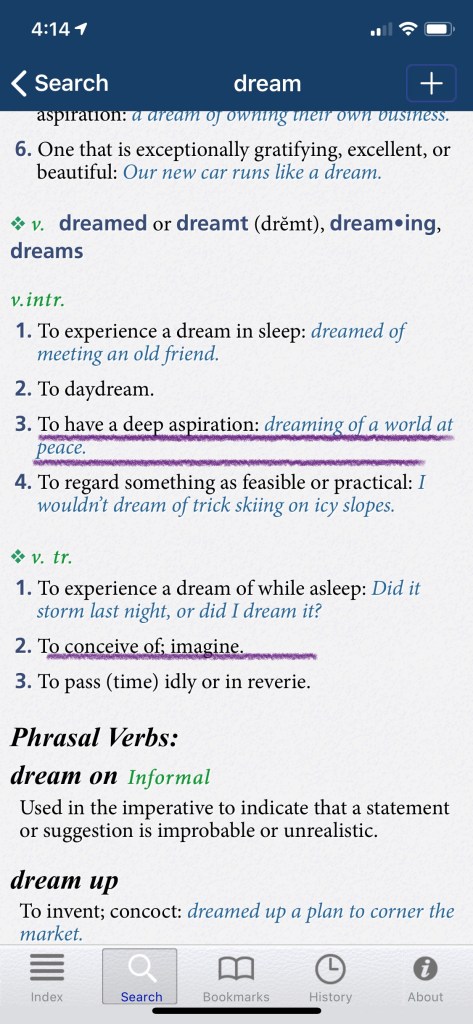
  • The American Heritage Dictionary (4th ed.)  defines the transitive verb form of the word dream as “to conceive of or imagine.” 
  • The intransitive verb form of the word dream is “to have a deep aspiration.”

3. I was formed in my momma’s womb by ADONAI.

  • Psalms 139:13b “You [God] knit me together in my mother’s womb.” TLV
  • Isaiah 49: 5a “So now says ADONAI, who formed me from the womb….” TLV
  • Jeremiah 1: 4 and 5a “The word of ADONAI came to me saying: Before I formed you in the womb, I knew you….”

Conclusion:

Dreams, in the sense of having deep aspirations, begin with an image or a vision.  Dreams such as these require hard work and dedication to manifest into reality: There is no magic bean to produce Jack’s beanstalk. 

Therefore, because I am made in the image of God, that dream conceived and imagined, and aspired to by God’s forming of my body in my mother’s womb, I can safely conclude that I am a dream come true! 

#Where Did My Belly Button Go?

Health experts say sitting is the new smoking, meaning consistently sitting long hours is just as detrimental to one’s health as is smoking.  I have spent the last five years sitting on my fanny an awful lot while pursuing a higher education.  Since graduation, binge watching my shows seems to be more enjoyable than cleaning out the pantry. Consequently, me ol’ belly button has moved.  

I used to be an active person. In a far-away past I had always found ways to move that was enjoyable to such as walking trails, riding bicycles, or aerobic stair stepping routines via VHS tapes in the 1990s. I even started taking backpacking camping trips.  

My outdoor, fun-in-the-sun activities came to a screeching halt in 1999 due to severe burns. Although healed, being in the sun became physically painful. It’s akin to having a sunburn and stepping outside under the UV rays. 

Yet in my pre-burn youth I never did like going to the gym: For one, I couldn’t afford the fees. So, in inclement weather I found plenty of ways to stay fit. I’ve been known to walk in circles inside my house––I had a house conducive to doing so––until I reached a mile or jumped rope 45 consecutive minutes or danced around for a pre-set time allotment. Ah, those were the days, my friend! 

The kids were always commanded ––yelled at––to stay away from Mom during these times. A daughter and I were reminiscing, and she surmised that it was because I didn’t want them to see my red face! I didn’t have the heart to tell her it wasn’t that but my sense of “me time” was being invaded. (Sorry, kids, if you happen to read this.) I’ve concluded this is why I don’t fully enjoy going to the gym––chalk it up to my introvert tendencies. (And yes, my face does get very red.)

But I digress. 

Over the years, I have participated in Yoga, Zumba, and aerobic classes, none of which I have truly enjoyed doing as a group. But my all-time favorite gym experience was at the local YMCA: Drumming. These routines entail pounding sticks on a yoga ball while dancing around. I suspect I loved it because I sometimes play the drums and I do own a drum kit. I’m the one air drumming and crashing cymbals while everyone around is strumming riffs at air guitars or singing-into-the-spoon. 

In the few weeks before the required Stay-at-Home orders went into effect, I met with a personal trainer once a week to work on strengthening my core. I was blessed too find one to come to my home once a week until COVID19 showed up in a fast and furious way. 

There is a plethora of opportunities to subscribe to virtual work routines, yet I want to recommend Dale Maynor at https://www.dalemaynorfitnesstraining.com.

I’ve kept the routine going sans trainer; but I decided I needed to get the whole body moving. So, I dug out the plastic aerobic step system from storage.  Two days later (yep, I tend to procrastinate), the search began on YouTube for a routine to follow and I was delighted to find an original Susan Powter video.

In the early 2000s, I was faithful to Powter’s “Lean, Strong and Healthy” aerobic stair stepping video.  I thought she was pretty cool although I never figured out exactly what insanity she wanted to stop. I was too busy huffing and puffing and blowing the house down to give a rip.

It was from Powter that I first learned a more proper posture that promotes better results in working the core: pull your belly button in as if to touch the spine.  Within two minutes upon my reunification with my old friend Susan and the “Lean, Strong and Healthy” routine, I began to wonder if I still had a belly button and if so, where is it?  

As it turns out, I do have one but there is much more distance to cover these days until it reaches the lower spine. Still, I did my best to bring a meeting of the twain––obviously much easier when I was 50 pounds lighter and a tad younger.

This pulling-in-the-belly-button-to-spine activity helps open up and lengthens the spine: It’s especially therapeutic for those who have been under the influence of gravitational pull longer than some. It’s good to practice throughout the day as well and helps relieve back pain. 

Many people’s social lives revolve around faithful gym attendance like some society’s neighborhood pub serves as a social center.  My introvert-self is quite content to step up and practice my belly-buttoning-pulling-in routine in the happy and sometimes bored confines of my home. 

For the curious or like-minded souls check out Powter’s video:

NOTE: The music as well as the video quality really sucks. One pet peeve to video routines is the music. Sometimes it reminds me of porno tunes––so I’ve been told; please, don’t ask. So, I muted the sound and streamed my Amazon Music workout playlist to a Bluetooth speaker.  Things really got a-movin’ and a-groovin’ to Lover Boy’s “Lovin’ Every Minute of It.” 

They lied: I only loved the first two minutes. 

As the World Turns…

As the World Turns Pauses

It’s obvious that as the crisis of COVID19 looms over the globe, we the people have put our normal lives on hold. Life as we know it has paused.  The hardship of this unprecedented time is unfathomable; for everyone. Yet, I have observed a few personal benefits since Shelter-In Place (SIP) orders were established. 

I never thought I would see the day when one buys five years’ worth of toilet paper, leaving the rest of the community with none.  The plus side of this marvel  is that I visualize the astonished expressions on my great-grandchildren and great-great grandchildren’s faces when I regale the tales of “back in the day.” I’m confident they will be googling to verify that Granny’s story was not the crazed rambling of an old woman. 

I am, by nature, a homebody. My only so-called social outing these days is the essential business of buying groceries. Staying six feet away from fellow customers is no problem for me because my innate need of personal space is just about that. Also, bringing a bag from home means I must bag the items myself, saving me from the idiot check-out person who places a loaf of bread and dozen eggs under the weight of a gallon jug of milk. 

On the plus side of SIP, I have only burned through ¼ tank of fuel in the past 3 weeks or so. Another plus is that I have had less laundry to wash because I dress in my stay-at-home clothes (que images of sweats and ratty t-shirts) rather than rocking business attire. Due to my having the nature of an introvert, I have truly enjoyed free curbside-pick up when ordering items online from local stores. I wonder why I haven’t been doing this all along until I remember the convenience fee attached to the total bill. 

I also have much more time available to declutter the house, write, enter the rabbit hole of Ancestry.com, shred oodles of piles of snail mail, learn a few software programs purchased and downloaded many moons ago such as Scrivener.

You may have picked up on the “time available” verbiage in the above paragraph. My busy pre-stay-at-home schedule often had me lamenting if I had more time, I would clean out the garage, the pantry, etc.  This season of SIP illuminates the great self-revelation that behind those excuses, the reality of “I JUST DON’T WANT TO” is starkly exposed. 

The bald truth forces me to confront me. As we ogle each other, one of me vocally gives permission to sit on the couch and stream movies all day.  While the other me simply wags a finger and the inner monologue says tsk, tsk, tsk, what about that to-do list?  

Even though I have strongly suspicioned that particular character flaw exists within for quite a while now, I can no longer deny I have a problem.  It is not that I’m totally lacking in self-disciple.  For the past few months, I have managed to complete a list of five things I do daily.  I say this flagrant revelation is a benefit in the fashion that one must lance a wound before healing can begin. But perhaps the biggest roadblock to getting things done is that of procrastination: I can happily talk myself into the wait-until-tomorrow phenomena. 

I once bought a self-help book on how to stop procrastinating.  I kid you not that in the 14 years I have owned that book, I have yet to read further than the title page. I imagine a group akin to AA in which I introduce myself “Hi, I’m Janet and I’m a procrastinator” followed by a group reply, “Hi, Janet.” 

 And the dance begins.  Should I give myself permission to do nothing but watch movies and binge serial shows (all the while visualizing a wagging finger and hearing tsk, tsk, tsk) and wave the flag in surrender to the screen? Or wait until I finish all items on that supposed list, the list that has turned into a short novel? 

Tada! I have found the perfect strategy. (Turns out, I am also great at compromise with inner conflict.) I will watch an episode; check an item off the list––after completion––of course and repeat. By the time the SIP order is lifted, only a small number of things will be checked off the list and I will be lamenting once again that I just don’t have time to do it all.  And it will be legit. 

Trash Collectors ––An Underappreciated Profession

Photo by Vladislav Vasnetsov on Pexels.com

In my last post I wrote about completing a daily gratitude list of a minimum of 20 items. Some things that I am most thankful for show up repeatedly, such as indoor plumbing. (See previous post for the reason I don’t take indoor plumbing for granted.)


Why purposely practice an attitude of gratitude? As it turns out, according to the Psychology Today website, author Amy Morin, claims there are seven scientifically proven reasons why one should practice gratitude. Gratitude improves one’s physical health, mental strength, psychological health, opens the door to more relationships, build’s self-esteem, reduces aggression and builds empathy. Interestingly enough, thankful people sleep better and longer. 

 (https://www.psychologytoday.com/us/blog/what-mentally-strong-people-dont-do/201504/7-scientifically-proven-benefits-gratitude).

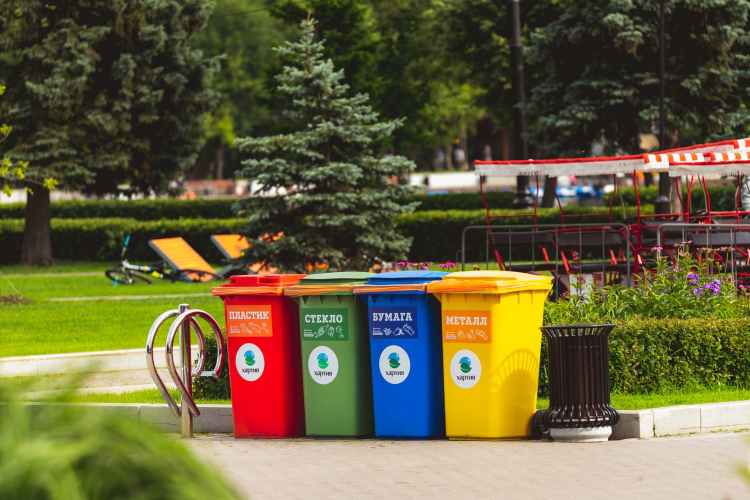
For the past couple of weeks, gratitude for garbage collectors has cropped up on my list a couple of times.  This also ties to my childhood, country living days when our household was responsible for hauling our trash to the local landfill­­ (or the dump as we called it­­), burning it, or sometimes Dad would even bury it. That’s country living.

In my country-living days, we children were responsible for getting trash outside of the house. Once outside, getting it off the property was up to Dad.  There was a special, sturdy barrel for burning. Once, a can of hairspray escaped our notice and it exploded sending shards that hit my younger sister near the eye. Dangers abound with this method. Some things were burned inside the woodstove, our only source of heat. 

Things that couldn’t or wouldn’t burn were piled up until a pickup truck bed was filled. Then it was off to the landfill. The few times I rode with Dad were father/daughter bonding moments until he began backing the truck to the edge of the stinky gorge. Panicked cries of warning­­––“Stop, Dad! You’re going too far!” and “We’ll fall in!” –– were met with chuckles. It didn’t occur to me that Dad didn’t want that to happen anymore than I did. 

I know some city dwellers who opt out and carry away their trash to the local waste disposal site thinking it will be cheaper. Tally up at least twice monthly trips at an expense of about $27 a load, it works out about the same amount of money as the city charges for curbside service.  Not to mention garbage sitting around stinking and attracting vermin for weeks at a time. EW! 

Photo by Juan Pablo Serrano Arenas on Pexels.com

I’m thankful that all I need to do these days is collect from the house, toss it a bin and wheel it out to the street curb and wait for man and machine to haul it far away.  Besides, I don’t quite   trust myself to stop the truck before it rolls into the reeking ravine. 

Bedpans and Walther P38s Part 3

Part Three of a Family Christmas Past

The moment the kids had waited for 365 days arrived. I beamed at my family­­–– mostly for the expectant joy on all faces. I donned my Santa hat and began dispersing gifts. The family rule was to wait until everyone had all their gifts piled at their side. The teenagers offered to play Santa’s elves to speed things up. 

I gave the traditional secret Santa signal and madness ensued. The neat freak son-in-law trailed behind, best he could, crumbling shreds of wrapping paper into large, black trash bags. 

Holliss, seven, shrieked, “How did Santa know I like red foxes?” 

Her mother, Rebecca, the family baby, gave me the look that she was famous for and I asked what was wrong. 

“Really, Mom? You gave my daughter a water bottle that reads “‘What the Fox’?’’ 

I couldn’t answer. 

“Mother!” 

It was Christa, my second-born and mother to seventeen-year-old Janessa, who screamed, “What are you thinking? The Kama Sutra? A book on sex? She’s seventeen!” 

Oh boy, I thought, I know I’m in BIG trouble. Still, I said nothing.

“Gram-Gram.”

I turned toward the voice. It was Nathan––his face was as white as Christmas snow.  He told the room that Cohen had just opened his present. As he spoke, he twirled what looked like a toy gun in his hands. Nathan, 15, was a sharp shooter whose goal was to become a Special Ops sniper. 

“Did you know this gun is real? It’s a Walther P38. You bought a five-year-old a gun?”

The room was still, not-a-creature-was-stirring, not-even-a-mouse kind of still. And quiet.

I felt the blood drain from my face as I stammered, “I-I-I.”

“This is a mistake, Amazon doesn’t sell guns,” I yelled, and I snatched the gun away, “You all how Amazon is, remember the fuzzy elf slipper incident?” The details are best left unknown. 

I proffered a weak defense that I knew nothing.

Dylan started blubbering. His mother clutched him at the elbow and escorted him into a bedroom. 

Everyone began gathering their things. The grandkids begged to stay and be entertained by the annual reading of The Night Before Christmas, and the parents acquiesced. They helped themselves to a glass full of my home-brewed eggnog. I was thankful this year’s batch was alcohol-light. (The cook may –– or may not have––consumed the 32 ounces of rum the recipe called for.)  I noticed a flask being extracted from Rebecca’s pocket. 

I was called into the bedroom and Dylan tearfully told me the tale. He noticed my Amazon page open and thought he was being helpful. When questioned about the book he said he added that to the cart because Janessa likes to exercise, and the book cover looked like people were exercising.

He admitted he looked at toy guns for his cousin because he knew Cohen wanted to be a policeman, but insisted that he didn’t order one. I knew he was being truthful, making the mysterious appearance of a real gun even more puzzling. 

“How did you order?”

“Easy. Buy now with one-click, Gram-Gram.” 

“What about your mother’s stack of ten road signs that read ‘Drive like your kids live here’?”

“I have little sisters.” 

I was thankful he didn’t order a sleigh full of toys. Or an Oozie. 

Gram,” Dylan added, “When I was playing Minecraft, you got an email attachment that I clicked on. They might have downloaded spyware.”

“It’s O.K., Dylan. I’m not mad and you’re not in trouble,” I comforted, “I’ll get to the bottom of this after Christmas.”

 I remembered getting a package that didn’t quite look like it came from Amazon, but the gift inside was in wrapped in Santa Claus paper so I shrugged it off.  My imagination exploded like gas on flames and visions of ruthless arms dealers in Nigeria popped into my mind. 

As I turned to the hopeful crowd waiting for their story, memories of my own childhood prank streamed like an Amazon Prime movie. When I was nine, my little sister, Lisa, and I walked across the field to Gramma’s house. She was outside hanging clothes on the line and unaware of our presence. I had a flash of brilliance and coerced Lisa (so she claims) into making the house appear ransacked. Then we hid while waiting for Gramma’s reaction. 

No one laughed at that either. 

Bedpans and Walther P38s–Part Two

BedPans and Walther P38s
(Part Two of a Christmas Past)

image_563655577775967
Photo Credit: Jessica McCollam jessicasvisionsphotography.com

It was seven days before Christmas, and I still had to purchase gifts for 21 grandchildren, two great-grandchildren, and 10 adults. Technically, Christmas was eight days away, but our family gathers for dinner on Christmas Eve, opening gifts after the grandchildren wash the dishes.

Ho! Ho! Ho! Oh, here I go. I snuggled into my favorite love-seat position: blanket; feather-pillow; pajamas; steaming mug of coffee latte at the ready, with the Amazon page brightly shining and resting on my lap. Christmas / Saravejo 12/24 by the Trans-Siberian Orchestra transmitted via Apple TV. The music  was so loud that I thought I heard the neighbors singing along.

I read that Amazon Prime members were extended an offer-of-the-day to have purchases gift- wrapped for free. I started to clap my hands. I had forgotten I was holding the latte, and nearly doused my shopping cart.

The doorbell rang. I was greeted by a small crowd; my third-born daughter, Angela, her six-month-old twin daughters, Annakate and Adeline, and her ten-year-old son, Dylan. I welcomed them in, and as they were seated, Dylan spied my computer and asked if he could play Minecraft on it.

“Of course,” I said with a wink at the platinum-haired boy, “That’s why I downloaded it, silly Dilly.”

He carried the laptop to the dining table and I set my attention to oohing and awing over the twins.

They left. I returned to my Amazon shopping, made my selections and set about washing dishes, making the bed, and tossing clothes into the washing machine.  As I cleaned, I made a mental grocery list for the big dinner. Then, it came to me; a jolting revelation, so jolting I swear I heard the angels sing. I could order all my groceries on Amazon.

*     *      *     *     *

I opened the door to the UPS delivery truck driver asking for my signature and I happily signed, although I wasn’t sure why this particular delivery required a signature; she didn’t look happy. She must have made 12 jaunts––truck to doorstep, using a dolly–– getting more red-faced each time, as I gawped. Her parting words were something about why I thought I needed 42 Christmas hams and concluded with a caustic Merry Christmas as she offered a hand signal that may or may not have signified her IQ level.

I smiled, dripping with saccharine to shield my consternation, I called out something about her job security. I ogled (my face as frozen as the hams) for a few minutes at the mass covering the front porch and decided the Amazon SNAFU could be dealt with in the morning and began dragging the boxes inside.

The new day arrived; the sun shining in a clear blue sky despite putting my order with the Big Guy for snow. I wondered if I should have checked for availability with Amazon Prime.  I hoped and prayed that the one special gift would arrive before dinner as I baked all day for the expectant, hungry horde.  The gift was delivered at last, and I placed it upon the swollen mound that exceeded the ‘under the tree’ notion.

I rang the Amazon office contact number only to reach an automated response: closed for the holidays, please try again December 26, 2017.