Ya Really Can’t Go Home Again 

Updated and Rewrite of My Little Town,  First written May 2018

Link below for your listening pleasure:
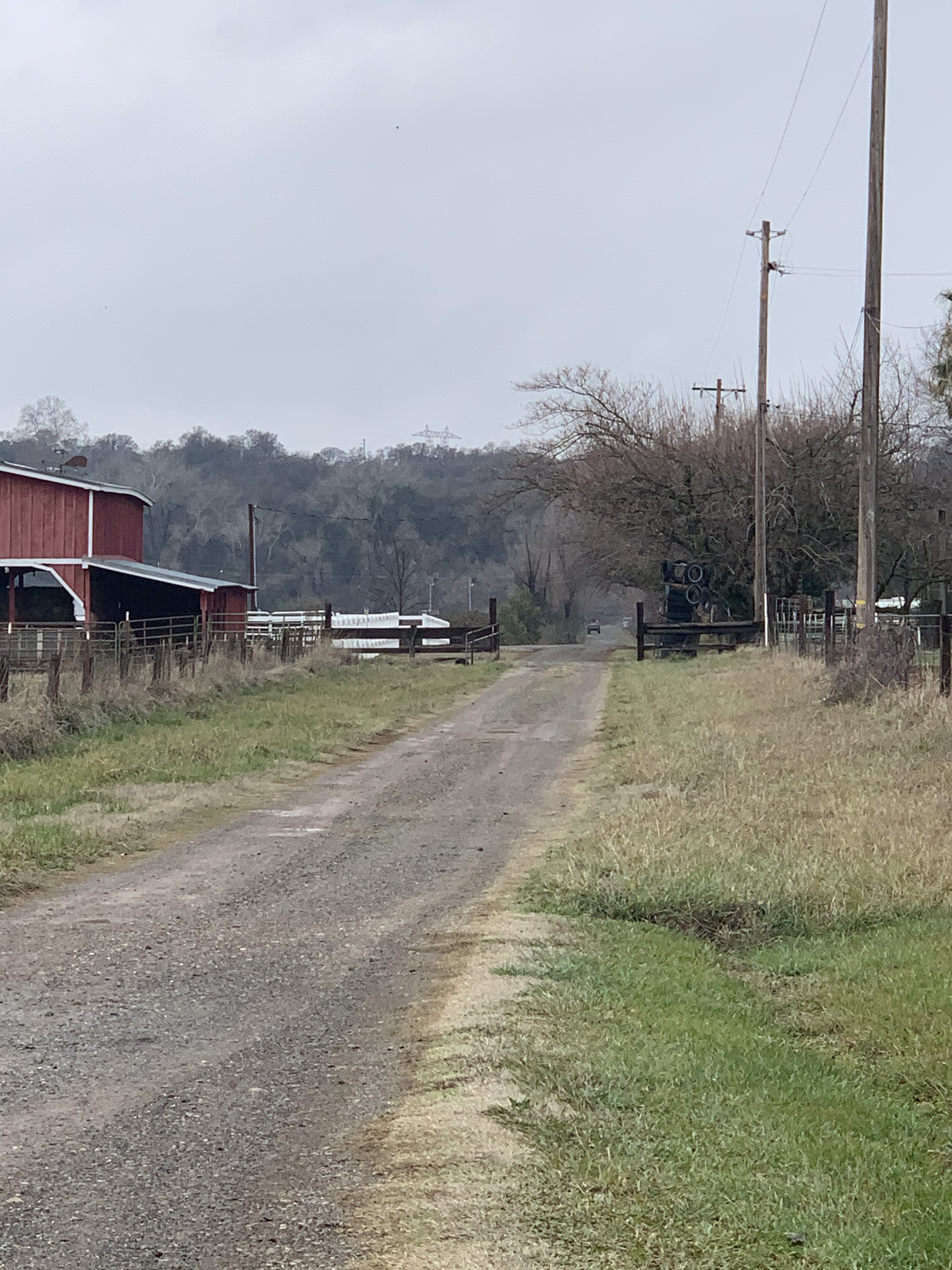
a gravel road in the country

https://www.youtube.com/embed/S42_znsIVmA?si=cLPhxU9kDmz0au6Q

Mom surprised us all by going before Dad. 1,778 days later, he followed her.

In the intervening years Dad was capable and willing of doing for himself. But the 64-year relationship was built upon Mom doing all things indoors and Dad conquered outdoor chores on the small ranch. It fell upon a couple of family members to fill the gaps of cooking meals, a bit of banking, and other oddball tasks. For me, the oldest daughter, it was more about being with him as well as stocking the fridge with casseroles and desserts. 

It meant Sunday afternoon visits after church. It was a short drive of about 20 miles to the childhood property I grew up on. It was still home to me despite Mom not being around. 

One week necessitated a midweek trip to dear ole’ Dad’s. He needed my help with some banking back in my little town. Coincidentally, the tune “My Little Town”  (Simon & Garfunkel) repeated in splendid reverie as I turned onto his little lane. I crooned the lyrics of the chorus, “nothing but the dead of night back in my little town,” and for reasons unknown curiosity compelled me to pull over and Google the lyrics to the full song.  

I was stupefied to learn that for the past umpteen years I’ve been belting out incorrect words. According to lyrics.com, the correct lyrics are “nothing but the dead and dying  back in my little town.” My bad. 

At the time, dead and dying seemed to be more appropriate at that time; from 2016 to 2018 my little town had lost my mother and three aunties, two of whom I was especially close to. Dead and dying spoke

The lyric of the song seems to imply nothing productive comes from their little town whereas my little town has lost four bastions of strength, grace, faith and character.

I prefer to keep my version. Maybe it is born from habit of many years. Maybe it’s plain stubbornness––I’ll keep on keening “nothing but the dead of night.”

The Sunday afternoon and mid-week visits have ceased. Although the property now belongs to me another family lives there. When my outings take me to the little ranch at the end of the lane, it doesn’t feel like home, making the ancient adage true: you can’t go home again. 

Gosh darn it––I must take my leave before this earworm leaves me in a puddle. (Insert humming sounds.)


a close up of a cows face

Photos of Defunct Signage

Signs That Provoke Memories

by Janet Spoon

My little town in far northern California has many now defunct signage––stores out of business, and some for many years. I am tempted many times to grab snapshots of each (most of them) carry childhood memories, but I am not a photographer. At least that is my excuse for failing to do so. 

This sign of Gene’s Hamburgers has special memories of grammar school days with clothes shopping trips to the “big city” of Redding, California. We lived in the country between two tiny towns with few people about 20 miles south. My parents were frugal, pragmatic people. We rarely ate meals outside our home. We raised our own beef and had a large garden; the logic was why pay for food when we have plenty at home? 

The rare exception was a trip to Redding for items not found in our local stores, such as the awful oxford black and white shoes we girls we forced to wear for the first few years of school. I would say God-awful but why should he get all the blame?  But I digress.

Redding trips were exiting because cheeseburgers, fries, and Coca-Colas were on the lunch menu. And Gene’s Hamburgers was the family favorite. For decades Genes was the local social hangout for car enthusiasts, but today it has been razed including the sign. The lot sits empty and forlorn.

One the last meals I had with my grandmother was from this hamburger joint. I’m thankful I had the foresight to snap this pic years ago when I first heard of the plans to close the place.

Echoes, Part 1

farm against sky
Photo by Sebastian Voortman on Pexels.com


I’m posting, in two parts, a short story written as a classroom assignment. This is based on true events that occurred in the ancestral line of my paternal grandmother, my great-great grandparents, John and Eliza Yoakam, who settled in Coos Bay, Oregon in the mid 1850s.


Echoes, Part One


“Turn left here,” Jack yelled.

“No, the map says to turn right,” Holly retorted as she grasped the dead man’s knob on the wheel and turned the large, black Dodge truck with a 5thwheel in tow onto Cape Arago Highway.

“Maybe you’d rather drive,” Holly teased, smiling at her tow-headed husband.

Holly guided the rig toward the RV park near the beach in silence.  She thought of the purpose of the trip and hoped she would find answers to nagging questions. Her great-great-grandmother, Eliza Davis Yoakam, and her husband, John, had an experienced a tragedy March 27, 1855, near Coos Bay, Oregon.

The Yoakams had followed the Oregon Trail from Ohio and chose to settle in Empire City in 1852. Eliza, one of the first white female settlers to come to Coos Bay, crossed the nation while pregnant with their eighth child. The Trail had claimed the life of the oldest boy. She gave birth to a girl three days after arriving.  Holly tried to imagine how difficult that must have been for her–– alone without her mother’s support. What amazed Holly more was how Eliza had managed to carry on after that fateful night in March, three years later. How does one go on after that?That dogged pioneerdetermination.

Eliza and John lost all five of their daughters during the night, one a babe in her arms. A freak windstorm gusted a large tree upon their makeshift cabin; a branch hit Eliza and the girl she held. Two toddler boys, George and Jasper, survived because they had been tucked in a trundle bed–– and had slept through the ordeal. George was Holly’s great-grandfather.

68724860_130342944562
Eliza Yoakam

She noticed Jack’s fingers tapping near the passenger window. She thought about how much coaxing it had taken for Jack to agree to the trip. He failed to understand her need to see ancestral grounds and thought it morbid to explore the site of tragedy. She bribed him with dinner at the “best Italian restaurant in two states.” Holly couldn’t remember the name, and Jack had teased her how great could the food be if she couldn’t recall its name. She reminded him of the power of Google and said not to worry.

That evening they dined on their traditional beach fare of salami, Swiss cheese, sourdough bread and red wine resting on Holly’s handmade quiltlaid upon the brown-gray sands of Arago Beach, sitting cross-legged and facing each other, against the backdrop of an August sapphire sunset. Milky swirls, aquamarine clouds on hovered close to the setting sun on the Pacific horizon. The sun morphed to a reddish golden globe, a utopian aura casting an array of colors, like rainbow Sherbet, into the clouds as it began its final descent into the ocean waves.

Jack prepared a pit in the sand, piling wood, kindling, wads of paper, and lit the heap with a cigarette lighter. As flares of red flames leapt high, he relaxed and reached for the boxed wine.

“May I?” he asked as he offered to fill Holly’s ‘wine glass,’ their beach term for a red SoHo plastic cup, “You look ravaging in the fire light.”

Holly teased that it was the wine talking, secretly pleased at his compliment, and set out their camp chairs.

“Good idea, Holly, my bones were starting to ache,” he said as he plopped into it.

They discussed the following day’s itinerary and decided to visit all the places on Holly’s list and the next day check off Jack’s list. The special dinner would take place on the eve of the trip home.

They smiled at the antics of the young children and their parents who had walked onto the beach, making S’mores over their small fire. Moments later, a large group of young men, drunken and loutish, caused the family to pack and leave. Holly and Jack looked at each other and without speaking, gathered up their belongings, doused the fire with sand and trudged under the blue-tinged, muted yellow glow of the half-moon to their sanctuary on wheels.


My Little Town––My Earworm

My father, 81, still lives on the property he acquired from his father in the mid 1950s. I visit him on a weekly basis, typically Sunday afternoons.

On my most recent Sunday visit, I decided to listen to some oldies, via Pandora, on the Simon & Garfunkel station.  My current town is about 20 miles from my childhood home, so I was enjoying quite a few oldies and the pleasant memories associated with each song.  As I turned into the long drive way, “My Little Town” (Simon & Garfunkel) began to play. That song has earwormed its way into my head for the past week.

A midweek visit was necessitated–– Dad needed my help with some banking back in my little town. Coincidentally, “My Little Town” repeated in splendid reverie, as I turned onto his little lane.  As I wailed the lyrics of the chorus, “nothing but the dead of night back in my little town,” my curiosity compelled me to Google the lyrics to the full song. (I’m a lyrics kind of girl.)

I was stupefied to learn that for the past 43 years, I’ve been belting out incorrect words. According to lyrics.com, the correct lyrics read “nothing but the dead and dying back in my little town.”

My bad.

Dead and dying seems to be more appropriate of late, as in the past two years my little town has lost my mother and three aunties, two of whom I was especially close to.

The lyrics of the song seems to imply nothing productive comes from their little town: whereas, my little town has lost four bastions of strength, grace, faith and character.

I prefer to keep my version. Maybe its born from habit of 43 years. Maybe it’s plain stubbornness.  So, I’ll keep on keening “nothing but the dead of night” safely within the confines of my little black car on my way to my little town.